Showing posts with label Designing Wargames. Show all posts

Sunday, 8 December 2024

Matchbox Challenge - Finishing up (Part 5)

The final step of the matchbox challenge was for me to write up the rules (click here for post on rules). Since I do not have access to a printer yet (our household goods are sitting on Wellington docks waiting for customs inspection) I had to handwrite everything. I realised it has been half a century since I have handwritten any rules, aside from brief reminder notes. The last time was in my early teens when I copied rules from the book “Practical Wargaming” borrowed from the library. 

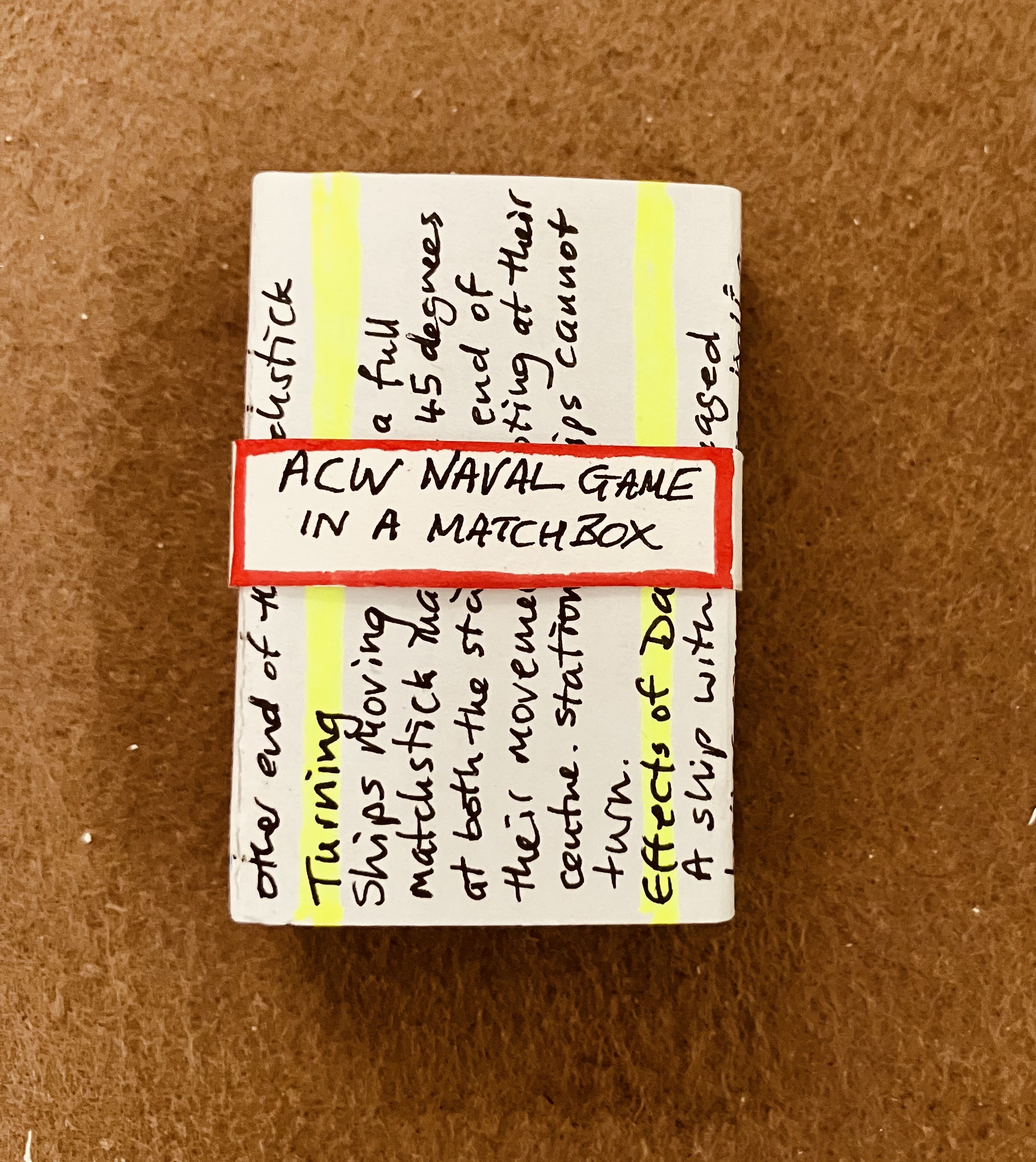
In a previous post I mentioned that the best way to save space seemed to be by unfolding the outer matchbox cover and using it to write the rules on. This idea needed a slight adjustment, as the rules did not fit. To solve this problem, I extended the paper covering the matchbox so it still wraps about the “drawer” and, with my neatest and smallest handwriting, I managed to fit all the rules. There was sufficient space to add a couple of tables. The finished matchbox is held together with a paper band.

The finished wargame in a matchbox. The matchbox is held together by a paper band.

With the paper band slid off, the rules and contents are revealed.

The rules are all written on the outside of the outer part of the matchbox which has been covered in paper and extended so all the rules fit. 

The flip side.

The contents

Some final notes…

I am considering adding an elastic band to the contents to represent river sandbanks. It would just fit inside the box or could be used to hold the box together, offering a more robust alternative to the paper band I made.

This has been an amazing challenge posted by The Duchy of Tradgardland and came at the perfect time for me, as my wargaming supplies have yet to arrive. Most of the challenge was completed using readily available materials: paper, colouring pens, card, a matchbox (of course), scissors, and string. I did have to purchase a glue stick and some Milliput epoxy putty used for making the ironclad models.

There is the option of using the upturned drawer of the matchbox to make a fort and to add a fort status card to the game (see photo below). Forts played important roles in the riverine battles of the ACW.

The damage rules from this game will work their way in my Mech game rules, as they are much more interesting and narrative-driven than my current system. Once that is done, I can return to my Mech campaign, which has been on hold while I worked on this challenge.

A rubber band is used to represent a sandbank in a game.

The rubber band fits snuggly inside.

A flotilla of ironclads try to pass a fort.


Friday, 22 November 2024

Joining the Matchbox Challenge (Part 1)

Two wargaming blogs I enjoy following, Man of Tin and The Duchy of Tradgardland, have been discussing a design challenge to create a wargame that fits inside a standard matchbox. This concept interested their readers and they have opened the challenge to anyone, with more details available here. The concept of making a wargame compact enough to fit into a standard matchbox intrigues me, so I have decided to give it a try. Over the past week, I’ve been pondering ideas for the challenge while also making progress on painting my house (and I am happy to report it's now halfway done! The house that is, not my pondering.)

A 30mm long ironclad model steaming along.

Not having any of my wargaming and modelling equipment available means I cannot reuse any models, for example, a handful of 15mm figures for a skirmish game. So I decided I would have to create some models for the challenge, while not fully ruling out land games, this has pushed me in the direction of naval and air wargame ideas. Both have the advantage of not really having to include any terrain features into the game, any features required would take up valuable space in the matchbox. The matchbox’s dimensions (34mm x 55mm x 14mm) set the size constraints for the project. 

In the end I decided on a naval-themed game. The American Civil War riverine battles with ironclads seemed like a good choice because their blocky designs should be easier to make using materials like card, toothpicks, and Milliput epoxy putty. 

Four prototype ships have been built to fit within the matchbox and still leave room for a single D6 die, each ship is 30mm long. Having four ships will allow for a variety of scenarios such as one-versus-three escapes, late arrival of reinforcements, or straightforward one-on-one duels.

The half finished models in the matchbox with a small die.

The models are complete and just need a bit of sanding before being painted in a mix of dark grey and brown.

The next steps in this challenge for me, aside from finishing the models, are:

  1. Create some riverbanks and sandbanks using string, which can be coiled to fit inside the matchbox.
  2. Write some simple rules that fit on a small sheet of paper to fit into the matchbox (around half the size of A4 or Letter paper) or that can be cut up and pasted onto the outside of the matchbox.
  3. Design ship cards for each vessel, including their details and stats to support the rules.
The next post on this challenge will be about the rules where I plan to use the matchbox as a measuring tool for movement and ranges.


    Saturday, 22 June 2024

    A little bit of painting and a new book about rule mechanisms

    In between wrapping up things at work for my retirement and preparing for moving house and country, which is now just three months away, I did manage to find time to paint a couple of samurai bases to add to my samurai armies. I may use these bases as messengers, tsuhai-ban, in my Senguko period samurai games as I am currently thinking of adding some messenger rules.

    A couple of Houhai-ban for my red samurai army

    On the gaming front, the book "Building Blocks of Tabletop Game Design - An Encyclopedia of Mechanisms" arrived in the post. The book is mainly about board game mechanisms, but it includes many rule mechanisms that are applicable to miniature gaming as well. 

    The new book. Paperback, 2nd edition, and 560 pages.

    The book is divided into 13 sections, each covering the different types of rule mechanisms:

    Game Structure - 10

    Turn Order and Structure - 17

    Actions - 23

    Resolution - 26

    Game End and Victory - 21

    Uncertainty - 14

    Economics - 20

    Auctions - 18

    Worker Placement - 8

    Movement - 24

    Area Control - 8

    Set Collection - 5

    Card Mechanisms - 9

    The numbers next to each section indicate the number of mechanisms described. Each mechanism is covered over 2-3 pages and includes:

    Name: Each mechanism is given a name (e.g., Ratio/Combat Results Table).

    Diagram: A diagram visually illustrating how the mechanism works. These are very clever and nicely done, almost a visual summary.
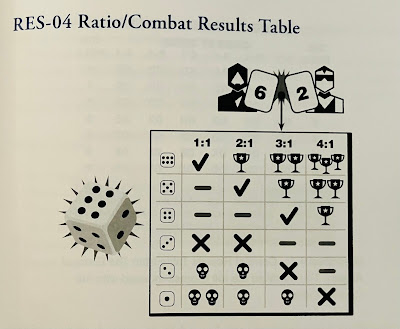
    The diagram the Ration/Combat Results Table)

    Description: A brief outline of the mechanism.

    Discussion: The largest section, which provides more details about the mechanism, including how it functions in a game, examples, occasionally an illustration, and advice for designers.

    An example illustration for the discussion on the Die Icons mechanism.

    Sample Games: A few examples of games that use the mechanism.

    It is not the type of book I will read start to finish, but is one I will pick up and read through a few rule mechanisms I’m interested in, or want to find out more about. The book is 560 pages long and is a really good browsing book if you are interested in rule mechanisms. I plan to use it for ideas when writing home-brew rules and setting up my campaigns. 

    The book is a bit on the expensive side for me and I did wonder if I had done the right thing when I clicked to purchase, but I am glad I bought it. I expect to get a lot of enjoyment from reading about new mechanisms, understanding how they work, and picking up new ideas.

    A samurai game currently underway on the tabletop.

    Sunday, 26 July 2015

    Thinking about rules again

    I'm currently reading "Designing Wargames - Introduction" by George Phillies. I'm halfway through the book, and while it is about board wargaming, it has caused me to reassess some of my rules for grid based SFI wargames. As I use a grid for wargaming it could be said I'm board wargaming with miniatures, my motivation to move to a grid was I got frustrated with having to measure move distances and combat ranges.