Showing posts with label Naval. Show all posts

Monday, 1 December 2025

Remote Napoleonic Naval Wargame

Since returning from holiday a coupe of days ago, my wargaming has been limited to a remote Napoleonic Naval game session with Jon from the Palouse Wargaming Journal blog which I hosted. We were testing a set of home-brew rules that uses a hex grid and playing cards (see here). The system plays quickly and we were able to play three games in about ninety minutes.

The first game involved two patrolling ships crossing paths, a straightforward engagement to familiarise ourselves with the rules. 

A photo of the first game as the patrolling ships exchange broadsides.

The second game was a three-to-one situation, with a lone ship attempting to breakthrough a blockade. This game proved to be rather one-sided, with the blockade runner quickly being contained and forced to strike its colours.

The blockade runner is contained and forced to strike its colours. All the ships are made from MDF and card, and any detail painted on.

The final game saw Jon and I each commanding a squadron of three ships, both seeking battle. This game proved to be quite a tussle with Jon eventually delivering a British victory.

The British squadron in line opens fire.

First blood to the British, but the French are about to even things up.

The British squadron maintains their formation and prepare to reengage.

The British gunnery eventually wins. 

Well done to Jon who was the overall winner with two out of three victories. Afterward, we chatted about the rules, particularly the “in irons” mechanic, which had previously required drawing a red suit to be able to turn, and also the wind-direction rule, where spades or clubs would alter the wind one point counter-clockwise or clockwise respectively. This made the wind far too changeable. 

This has resulted in the revision of both rules:
  • Ships “in irons” can now always turn.
  • Wind direction: If a spade is drawn, the wind shifts one point. Then draw a second card to determine direction:
    • Spades or Clubs: wind shifts one point clockwise
    • Hearts or Diamonds: wind shifts one point counter-clockwise
The next day, Jon emailed some suggestions for changes to the initiative that would better reflect the advantage of a player securing the "weather gauge" and positioning their fleet upwind of the enemy. I have not incorporated this change into the rules yet, but I intend to test the initiative mechanism in the coming days. 

The proposed rule change would have a card drawn to determine initiative. If the card's suit matches a player’s chosen colour (red or black), that player becomes Player A, and the other Player B. Movement then proceeds in this order:
  1. Player A moves any ships “in irons”
  2. Player B moves any ships “in irons”
  3. Player A moves any “close-hauled” ships
  4. Player B moves any “close-hauled” ships
  5. Player A moves ships “running with the wind”
  6. Player B moves ships “running with the wind”
Note - with simultaneous shooting the advantage generally favours the player moving second (Player B).

All ships must make one action in their movement phase unless they are “in irons”, where they can choose to remain stationary.

More information on the making of the ships can be found here.

Saturday, 25 October 2025

Napoleonic Naval Game Report and Rules

Last week my daughter visited for the day. When she is over we will often play a couple of One-Hour Skirmish Wargames using my Games Workshop Necromunda figures. It is a fast card-driven game that delivers plenty of fun moments.

A naval action underway using some ships scratch built from MDF and card.

This time, however, I decided to try something different, a Napoleonic naval wargame. I started with a simple set of rules from the Junior General website, but modified them to use a deck of playing cards instead of dice. I also introduced changes to the activation and movement rules, and the model ships are moved on  a hex grid rather than free movement. The full set of rules can be found under the “Napoleonic Naval Rules” tab at the top of the blog (or you can click here). The idea to play a naval came was prompted by week marking the anniversary of the Battle of Trafalgar on 21st October, 1805.

Over the course of the day, in between a few other tasks, we managed to fit in three games. The first couple of games were small engagements with just a few ships as we familiarised ourselves with the rules. The opening scenario was a simple patrol, with opposing ships unexpectedly crossing paths. The second scenario saw a blockade runner attempting to slip past three enemy ships.

A patrol game.

A blockade game underway.

For the third and deciding game had both the French and British fielding a squadron four ships, with the objective simply to engage and destroy the opposing force.

The French squadron, deployed in two lines running with the wind, closes in on the small British squadron sailing in line ahead. 

The French ships move into gunnery range, opening fire as they bear down on the British who return fire.

One French ship becomes entangled in the British line while others swing around to cut off the lead British ship.

The battle lines quickly become confused amid the smoke and cannon fire. One French ship has already struck its colours.

The fighting devolves into a series of fierce, ship-to-ship duels as the formations breakup.

Both fleets have suffered heavy damage, with several ships sunk or with colours struck. The remaining vessels manoeuvre to re-engage any enemy still afloat.

In the end, two battered ships remain locked in combat, neither able to gain the upper hand. The battle ends in a hard-fought draw.

A fun day of wargaming, with the final battle ending in a draw and honours shared. After the games I thought about adding a few more ships to the fleets, but with the space I have available, anything more than four ships per side would start to limit the ability of ships to manoeuvre.

Sunday, 19 October 2025

Preparing for a cheap and cheerful Naval Wargame

While sorting through and tidying up various free rule sets I have downloaded over the years to my computer, I came across a set of Napoleonic naval wargame rules. With the anniversary of the Battle of Trafalgar (21 October 1805) next week, it seemed like a good idea to get my scratch built semi-flat Napoleonic ships out of their storage box and onto the tabletop for a game.

I made these ships back in 2018 using 3mm MDF and card. However, they have rarely seen any action since. For those interested, the original post with details on how I built them can be found here.

My scratch built ships in action.

One thing I never finished at the time was adding flags to distinguish the ships of each side. So this weekend I set about remedying that by making some simple flags using nails and masking tape. The flags will slot into small holes drilled into the stern of each model ship. That way it gives me flexibility to use the ships for other nationalities.

Masking tape is attached to the small nails.
 
Holes are drilled into the stern of the model ships.

The flags are painted and await a coat of PVA to seal them.

The flags added to the French fleet.

With the ships now flying their flags, I set up the tabletop using a blue felt cloth which on one side is marked out in hexes. Each hex corner (or vertex - I had to look that up) has a small dab of whitish paint to suggest waves, and the entire cloth is covered with a clear plastic sheet, which helps give a wet and watery look.

The dabs of paint mark out the hexes. I have drawn out a hex to give an idea of a hex.

Another missing element was a way to track hits. In my first test game, I used dice, but they looked rather out of place on the table trailing behind the ships. To improve on this, I cut some small square counters from 3mm MDF to record damage. Each counter has its sides numbered and is placed beside the ship to show the hits it has taken. Originally, the tokens were simply painted blue, but before adding the numbers with a marker I added a couple of washes and dabbed the surface to create a dappled effect. This helps to break up the flat colour.

The square counters. One counter as 1-4 on one side and 5-8 on the other. The second counter has 9-12 on one side and 13-16 on the other. This way I can if needs be track up to 16 hits.

The ship in the foreground has taken 7 hits and the one in the background has 3 hits.

All being well my next post will cover the game and rules for a small Napoleonic Naval engagement.

Sunday, 8 December 2024

Matchbox Challenge - Finishing up (Part 5)

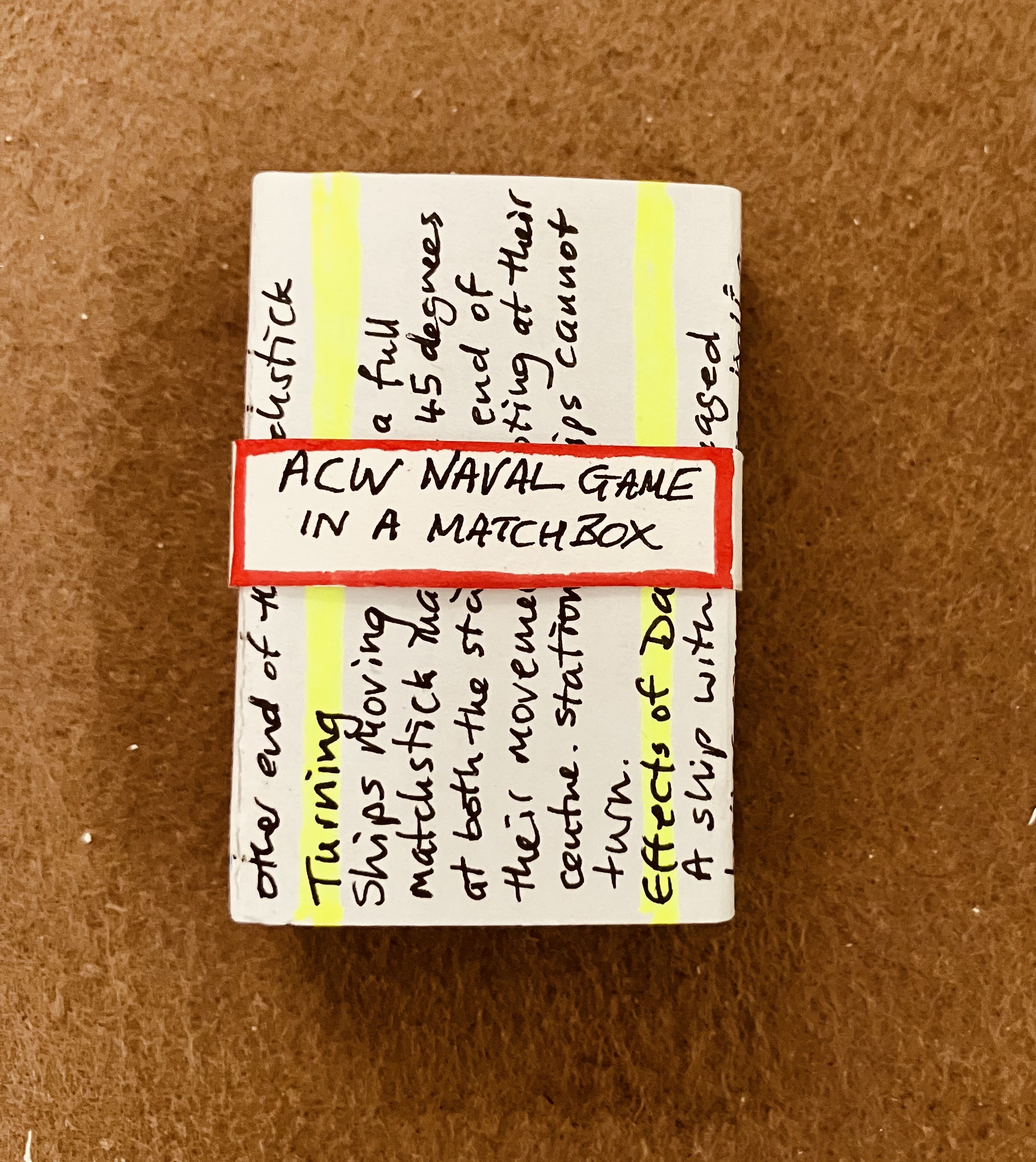
The final step of the matchbox challenge was for me to write up the rules (click here for post on rules). Since I do not have access to a printer yet (our household goods are sitting on Wellington docks waiting for customs inspection) I had to handwrite everything. I realised it has been half a century since I have handwritten any rules, aside from brief reminder notes. The last time was in my early teens when I copied rules from the book “Practical Wargaming” borrowed from the library. 

In a previous post I mentioned that the best way to save space seemed to be by unfolding the outer matchbox cover and using it to write the rules on. This idea needed a slight adjustment, as the rules did not fit. To solve this problem, I extended the paper covering the matchbox so it still wraps about the “drawer” and, with my neatest and smallest handwriting, I managed to fit all the rules. There was sufficient space to add a couple of tables. The finished matchbox is held together with a paper band.

The finished wargame in a matchbox. The matchbox is held together by a paper band.

With the paper band slid off, the rules and contents are revealed.

The rules are all written on the outside of the outer part of the matchbox which has been covered in paper and extended so all the rules fit. 

The flip side.

The contents

Some final notes…

I am considering adding an elastic band to the contents to represent river sandbanks. It would just fit inside the box or could be used to hold the box together, offering a more robust alternative to the paper band I made.

This has been an amazing challenge posted by The Duchy of Tradgardland and came at the perfect time for me, as my wargaming supplies have yet to arrive. Most of the challenge was completed using readily available materials: paper, colouring pens, card, a matchbox (of course), scissors, and string. I did have to purchase a glue stick and some Milliput epoxy putty used for making the ironclad models.

There is the option of using the upturned drawer of the matchbox to make a fort and to add a fort status card to the game (see photo below). Forts played important roles in the riverine battles of the ACW.

The damage rules from this game will work their way in my Mech game rules, as they are much more interesting and narrative-driven than my current system. Once that is done, I can return to my Mech campaign, which has been on hold while I worked on this challenge.

A rubber band is used to represent a sandbank in a game.

The rubber band fits snuggly inside.

A flotilla of ironclads try to pass a fort.


Thursday, 5 December 2024

Matchbox Challenge - Battle Report (Part 4)

If you have been reading the past few posts on the development of a matchbox wargame, you maybe wondering how does it play with the rules. This post is a game report on an encounter between a couple of opposing ironclads as they patrol a tributary of the Mississippi River.

(For details behind the wargame in a matchbox challenge see the blogs Man of Tin and Duchy of Tradgardland.)

Ironclads steaming down the river.

Background

Two ironclads are patrolling the winding waters of Silverbend Creek, a serpentine tributary feeding into the Mississippi River. The Confederate ironclad, CSS Thunderforge, is working its way upstream under the command of newly promoted Captain Calder. Heading downstream is the Union ironclad, USS Resolve, commanded by the battle-hardened Captain Barrett.


The game setup CSS Thunderforge on the left and USS Resolve on the right heading down river.

Game Report

As the two ironclads round one of the many bends of Silverbend Creek, they come into view of each other. Both ships open fire with their forward cannons, but at long range, neither manages to land a hit. Undeterred, they both press forward, closing the distance to improve their shooting and to inflict damage.

USS Resolve shoots. A D6-1 and subtracts a further 1 for firing forward. A score of 2 means a range of 2 matchsticks as their gunnery falls short.

CSS Thunderforge’s shooting is just as poor as both ships close.

Eventually USS resolve scores a hit which causes crew casualties on CSS Thunderforge. They will no longer be able to affect repairs to their ship.

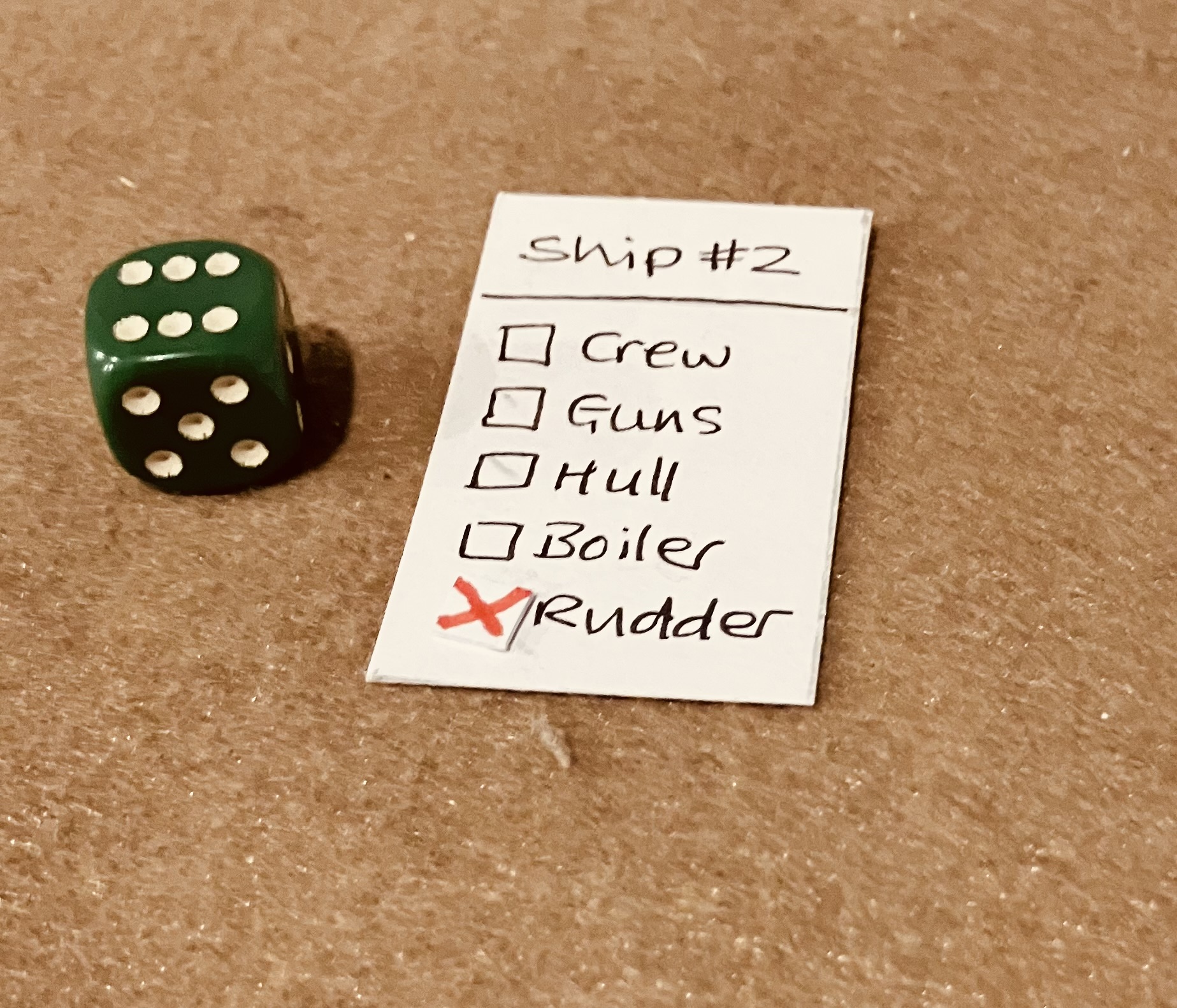
As the ironclads closed, the USS Resolve managed to ram the CSS Thunderforge, but the impact failed to inflict any further damage. The two ships pass each other and began turning around for another engagement. During the exchange, the USS Resolve sustained a well-aimed shot that damaged her rudder. However, her crew quickly sprang into action and successfully made repairs.

USS Resolve rams, but there is no damage.

On the damage table a second hit to the crew is ignored as the various ship areas can only be damaged once, unless they are repaired. However, crew casualties and hull damage cannot be undone in the repair phase.

USS Resolve has its rudder damaged. But with a full crew was able to later repair the damage.

As the battle continued, the USS Resolve landed several direct hits, damaging the CSS Thunderforge’s guns and boiler. Both crews by this time had suffered significant casualties, leaving them unable to carry out repairs.

Both ships turn to engage in battle again. USS resolve is now on the left and CSS Thunderforge is on the right.

CSS Thunderforge is suffering a number of hits and damage.

Leveraging her speed advantage, Captain Barrett on the USS Resolve orders another ramming attempt, which is successful, inflicting damage to the enemy’s rudder. Captain Calder, realising the severity of the situation, ordered his crew to abandoned ship as it slowly begins to sink.

A second ram by USS Resolve sees the enemy ship sink.

Wrap Up

The damage rules assign hits to various areas of the ship, such as the boiler, rudder, and hull, creating a more narrative approach to the game, rather than simply tracking damage until a limit is reached and the ship is eliminated. The rules allow the effects of damage to influence play, such as limiting movement if the rudder is hit or reducing speed when the boiler is damaged. While damage can be repaired providing there is a full crew, but crew casualties will stop repairs from being made. This approach helps with the storytelling aspect of the game, which helps create interest when there are only a small number of ships involved in a game.

Sunday, 1 December 2024

Matchbox Challenge - Drafting the Rules (Part 3)

This weekend, I have been drafting the rules for my wargame in a matchbox. I now face the challenge of somehow fitting them inside the matchbox without shrinking the text too much. However, before getting to the rules my first task was to create some hit markers to use with the ship status cards. They are small card squares 5x5mm with a Red Cross drawn on them, front and back so no need to worry about turning the fiddly things the right way up.

(For details behind the wargame in a matchbox challenge see the blogs Man of Tin and Duchy of Tradgardland.)

Matchbox contents. The rules are yet to be added.

Hit markers for use on the ship status cards to track damage.

A box contents list has now been added and stuck to the inside of the drawer. 

For the question of how to best to fit the rules into a somewhat full matchbox I may have an answer. The current solution (still a work in progress) is to see if I can make full use of the matchbox itself. By unfolding the box, I can write on both the inside and outside surfaces. To keep everything intact, I’m using some paper tape I made which slides over the outside to hold the box together.

The paper tape holding the matchbox together.

With the drawer removed the outer matchbox can be opened up and used to write the rules.

Draft Rules…

Since this game fits within a matchbox, it felt fitting to use matchsticks for the measurement of movement and shooting distances. I have now included five and a half matchsticks for this purpose. Below are the draft rules. I plan to use the inside of the matchbox drawer to sketch out how movement works, replacing the current photos I am using below.

ACW Ironclad Wargame

This is a matchbox wargame for playing riverine battles of the American Civil War on a flat surface of 2 by 1 foot. 


Game Setup

Lay the two lengths of string on the tabletop to represent the riverbanks, ensuring they are spaced between 4 to 5 matchstick lengths apart. Decide the direction of the river's flow and position the flow marker.


Sequence of Play

Each game turn is divided into the following phases:

  1. Movement and Ramming 
  2. Shooting
  3. Damage Resolution
  4. Repairs

Movement and Ramming

Ships move one at a time, starting with the one furthest upstream and proceed downstream moving ships.


On their movement turn, a ship has 3 choices:

  1. Stay stationary,
  2. Move half a matchstick length, or
  3. Move a full matchstick length.  

To move, place a matchstick touching the bow of the ship and facing straight ahead. Then slide the model forward so the stern aligns with the other end of the matchstick.


At the start of the move.

At the end of the move.


Turning - Ships moving half or a full matchstick length may turn up to 45 degrees at both the start and the end of their movement, pivoting at their centre. Stationary ships cannot turn.


Effects of Damage -  A ship with a damaged boiler can only move half a matchstick. A ship with a damaged rudder can only turn once, either at the start or the end of its movement.


Riverbanks and Sunken Ships - Any ships that make contact with a riverbank or sunken ship becomes stranded and immobile for the rest of the game.


Ramming - To ram, a ship can only turn at the start of its movement. If the ship makes contact with an enemy vessel, roll a die, consult the damage table, applying damage immediately. 


Shooting

Shooting is simultaneous and all ships get to shoot (even those engaged in ramming). The procedure is as follows:  

  1. Select Target - A ship may target only one enemy ship with a clear line of sight.  
  2. Range Calculation - Roll a die and subtract 1 to determine the shooting range in matchstick lengths. Apply the following modifiers to the score: -1 if shooting forward of the bow or rearward of the stern, and -1 if the ship has sustained gun damage.  
  3. Damage Resolution - If the target ship is within range place a hit marker next to the ship as a reminder they have taken a hit and need to resolve damage in the next phase.

Damage Resolution


When a ship is struck by shooting or ramming, roll a die and consult the damage table below:  


1 = Glancing Blow - No damage.  

2 = Crew Casualties - The ship cannot make repairs.  

3 = Hull Damage - Permanent; cannot be repaired.  

4 = Damaged Guns - Reduce all shooting rolls by 1.  

5 = Boiler Damage - Movement is reduced to half a matchstick.  

6 = Rudder Damage - The ship can only make one turn during movement.  


Record all damage on the ship's status card using the hit markers.


If a ship has already sustained damage to a specific area, no additional damage is applied to that area. For instance, if a ship with existing hull damage is struck again in the hull, the result is ignored. 


A ship with four hits begins to sink and can take no further actions for the remainder of the game. It remains in place as an obstacle to other ships.


Repairs


After all damage has been applied ships that are not sunk and have not taken crew casualties can attempt a repair. Roll the die and compare the score to the repair list:


1-3 = Repairs fail.

4 = Remove gun damage

5 = Remove boiler damage

6 = Remove rudder damage


A game setup and ready to play.