Showing posts with label 15mm. Show all posts

Monday, 15 December 2025

Making custom containers for Ancient miniatures

In my previous post, I mentioned that I was planning on expanding my Carthaginian Gauls so that I could field a full Gaul army, and that once painted and based I would need to find some additional storage space. My current storage system for my Carthaginian and Roman armies consists of nine stackable containers, each one is capable of holding up to nine bases. Unfortunately, I have not been able to find any more containers of the same type, and even if I could, a stack of four does not fit in the available shelving space.

After a bit of thought, I decided to have a go at making some custom containers using MDF sheets and my  schoolboy-level woodworking skills.

The current storage situation for my Ancient armies.

Each container holds 9 bases. The bases are 3x4 inches.

The plan was to build eight custom containers, each measuring 3 inches high, 16 inches wide, and 15 inches deep. The shelf space dictated the width and depth, while the height was determined by the 20mm miniatures (the elephants being the tallest). Each container would hold 18 bases, all my bases measure 4 x 3 inches. 

The finished containers.

The new containers hold 18 bases.

After thinking through a few ideas, I decided on the design shown below. This allows the containers to stack securely without sliding and toppling while still be easy to slid in and out.

A drawing of the design. Forgive the combination of imperial measurements and metric. With all my bases being in inches (the traditional wargaming measurement) it was easier to use inches for the construction while the purchased MDF sheets come in metric.

All the MDF pieces cut out for one container. The darker pieces are the side 12mm MDF.

The 12mm MDF is used for the sides.

3mm MDF is used for the front and back.

The thin 1 inch strips of MDF are glued to the bottom so the containers do not slide and topple in on each other.

A close up of how the containers are stacked.

A few quick notes on construction. The 3mm MDF sheets were attached to the 12mm MDF sides using PVA glue and 25mm (1”) panel pins. Five pins were used along each side to secure the base, and one pin per side was used when fixing the front and back 3mm MDF pieces. I did not glue or pin the front and back panels to the base. This simplifies construction and the containers are sufficiently strong without being fixed to the base. The thin MDF strips used to prevent the containers from sliding when stacked were simply glued to the base. 

One word of warning, avoid hammering panel pins too close to the ends of the 12mm MDF, as it will likely split.

PVA glue and 1 panel pins is used on each side to attach the front and back.

PVA glue and 5 panel pins secured the base to the sides.

25mm or 1 inch panel pins were used.

The base with the strips attached near the sides.

The end result is that I can now store 144 bases of ancients in the same shelving space that used to hold 81 bases. With each container holding 18 bases, eight containers will provide more than enough room for the planned expansion of the Gaul army. Best of all, this was a cheap solution which I completed over 2 days.

Sunday, 8 December 2019

ACW mini-campaign morning clash

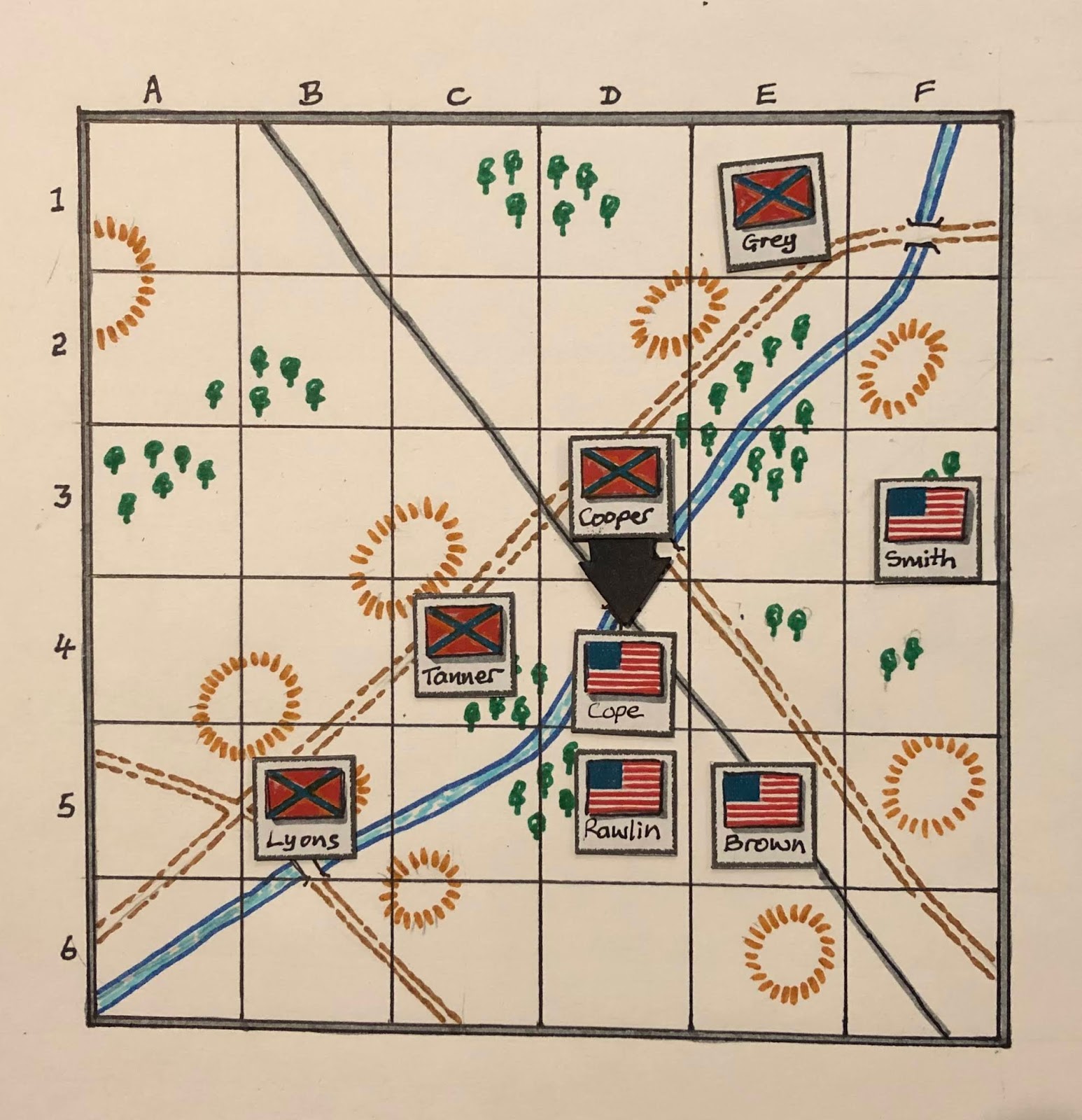
A quick reminder of the battle (mini campaign) which has four Union divisions trying to force a crossing of Redmond's River by capturing one or more of the bridges. The first actions occurs as Cooper's Confederate division moves south to defend the Railway bridge crossing against an early attempt by Cope's Union division to cross. The action is taking place the morning, 24th June 1863.

Union artillery battery in action
The battle will be over two days with each campaign move representing part of the day: morning, midday, afternoon, early evening.

The campaign - battle map the morning 24th June 1863
As both sides have a supporting division in an adjoining square they can draw upon a single reserve unit after turn 6 to add to their starting 6 units which are randomly generated at the start. Once a division's composition is determined it is recorded for the remainder of the battle (campaign).

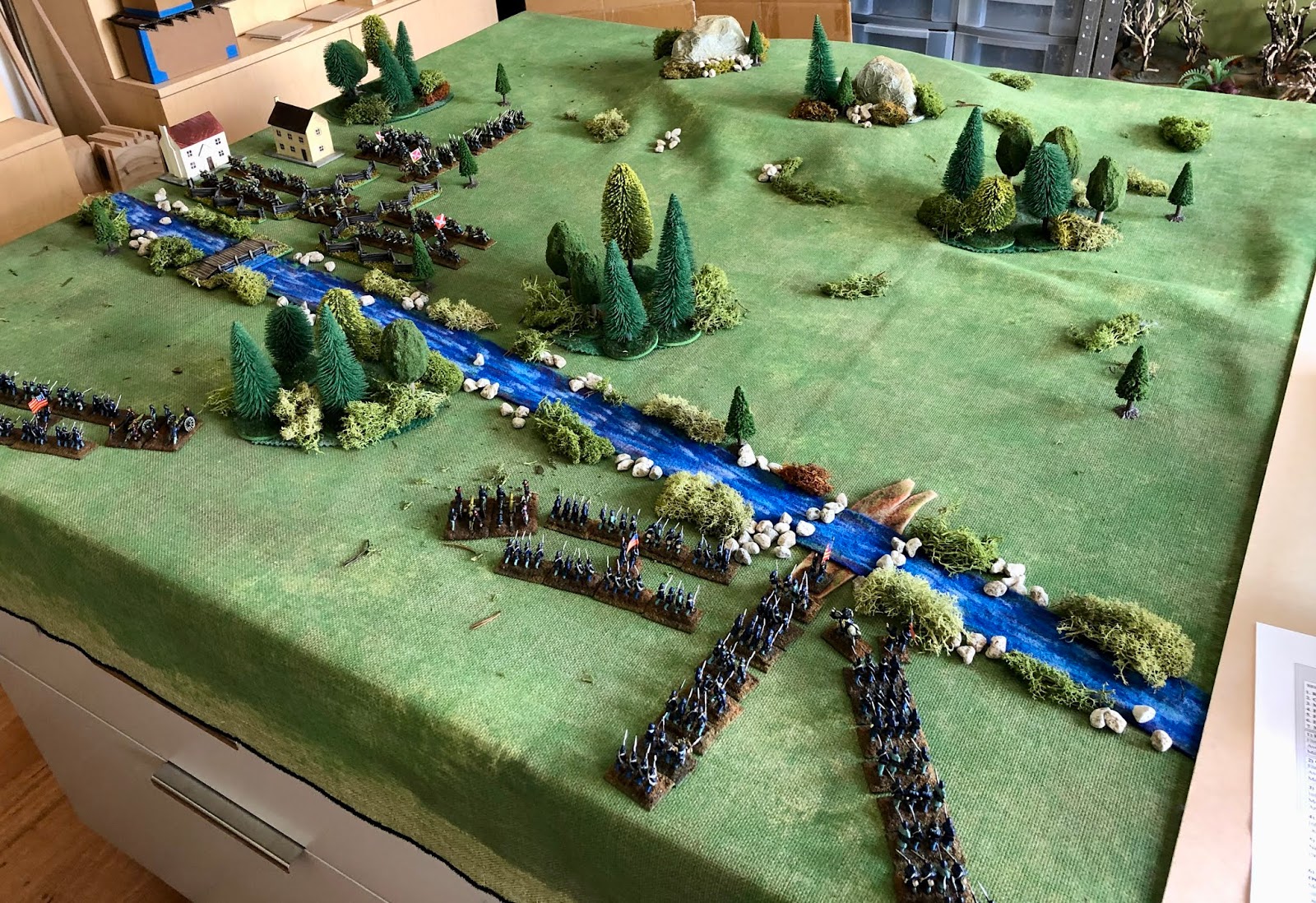
The table top was laid out a second time for this game. It had been packed away earlier in the week and sharp-eyed readers may notice some differences to the photo in a previous post. The order of battle is:

Confederate forces

  • 5 infantry unit
  • 1 artillery unit
  • 3 commanders
  • Option of 1 infantry reserve unit arriving after turn 4
Union forces
  • 3 infantry unit
  • 2 artillery unit
  • 1 cavalry unit
  • 3 commanders
  • Option of 1 infantry reserve unit arriving after turn 4


The forces are deployed
The Union commander, Colonel Cope, was rather pessimistic about the morning and being able to achieve his orders. He did have the advantage in artillery and a cavalry unit to quickly reconnoitre the river for any possible fordable lengths of Redmond's River, but his division was facing a strong Confederates force of 5 infantry units.

Both divisions pushed forward their units and skirmishing occurred at long range supported with available artillery units. Union cavalry were able to discover a fordable stretch of river and attempted a crossing quickly coming under skirmishing fire.

Both sides push forward. Union forces are hoping to find the river is fordable on their right flank.
Union artillery fire upon Confederate forces while their cavalry find a fordable stretch of the river and attempt a crossing.
Using their artillery to bombard the opposing infantry, forcing them to rout and retire. Union infantry managed to cross at the railway bridge, but had no supporting units, a risk venture. Reserve infantry had arrived from Tanner's division and were being rushed up as quickly as possible before Confederate forces were able to regroup.

As Confederate units retire and regroup after sustaining a few turns of artillery fire. Union infantry rush across the railway bridge.
Union infantry soon become exposed while reserve infantry try and move forward quickly to provide support.

Colonel Cope's pessimism was justified and he determined enough was enough, calling off the attack late in the morning. A Confederate success as they have control of the railway bridge. Cope's division retired eastwards.

From a campaign perspective Cope's division will next time field only 2 commanders. Commanders assigned to units allow them to re-roll movement and shooting dice. There will be more on the rules as the campaign progresses.
The Union commander calls off the attempt to cross the river.
With the Confederates in control of the railway bridge and Cope's division retiring eastwards. It is time to consider the next campaign move orders. In the case of Confederates this is two sets of orders which are diced for to determine which set to action. I am trying this approach instead of dicing for the individual divisional units as it provides more cohesive set of moves from the opposition.

The battle positions at the end of the morning.

Saturday, 16 November 2019

Rivers and an ACW game

This week I pulled out my old Minifig 15mm American Civil War (ACW) figures which rarely get a look in on the tabletop. For some reason, and I have no idea why, I decided it was time for an ACW game. Possibly as I an certainly in a Horse and Musket frame of mind at the moment with my recent Napoleonic gaming.

The week began with playing a game using the ACW rules from Neil Thomas's "Wargaming and Introduction", then moved to the One Hour Wargames version, and finally to a variant of the two which I will be posting after I have written up my notes.

A game set up and ready to play. I could not resist a black and white photo as I have been browsing Airfix Guide - American Civil Wargaming by Terence Wise since pulling out the ACW figures.
However, the purpose of this post is about rivers. Or more precisely sprucing up my blue felt rivers. As a general rule I like my terrain to be practical to use and easily made. So for a long time I have been using cut strips of blue felt to represent both rivers and streams. As I laid out the river on the tabletop for the next game I had an idea on how to hopefully make it look better with little effort.

My current river terrain
I recently purchased some oil pastels to help with modelling a St Nazaire project (which is still progressing slowly as I trial terrain options) and I thought I could use the pastels to break up the flat blue look of felt river. The oil pastels once applied don't easily come off the felt. If you remember ever having to remove crayon marks (drawings) on the walls made by your kids - that is how well the colour stays applied.

Oil based pastels are used (not the soft caulk type)

Here are some photos of the steps which took me all of 15 minutes.

A light blue is drawn in random lines. A bit of fluff is generated when applying the pastel and is easily removed when all colours are applied.
Additional brown and green is applied mostly around the river edges and to help the river look a bit murky in places. Finally white dashes are applied (see next photo) 
The final result with the white dashes added to make it look like a flowing river.
The game is now setup to play scenario 12 (an unfortunate event) from One Hour Wargames on a 4x4 foot tabletop.

All ready for action


Saturday, 10 October 2015

15mm WW1 Rolls Royce Armoured Car

Having rebased and painted the few remaining unpainted WW1 (Peter Laing) German miniatures over the last couple of weeks, I've been adding one of two scratch built vehicles. I don't spend too much time on them, I mainly aim to get the look without too much accuracy or detail. This week I added a Rolls Royce Armoured car and some pillboxes.
Scratch Built British Armoured Car
The pillboxes got a tryout in a game using scenario 4, take the high ground, from Neil Thomas's book One Hour Wargames.

Pillboxes help defend a hill

British Forces start their advance on the hill
I may add a few new items to my WW1 models for specific games, but the number of units suits my war-game table size (6'x4'). I am also out of Peter Laing British and German models. There are 3 or 4 French infantry units to paint to add some variety and I need a few more terrain pieces may be required, another bridge comes to mind.