Showing posts with label Chance Cards. Show all posts

Tuesday, 15 July 2025

ECW Game report - The Battle of Raventon Crossing

This is an English Civil War battle report following on from the previous post where some pre-game actions were tested to influence an army's deployment, composition, and also its readiness. While also helping develop the game’s narrative.

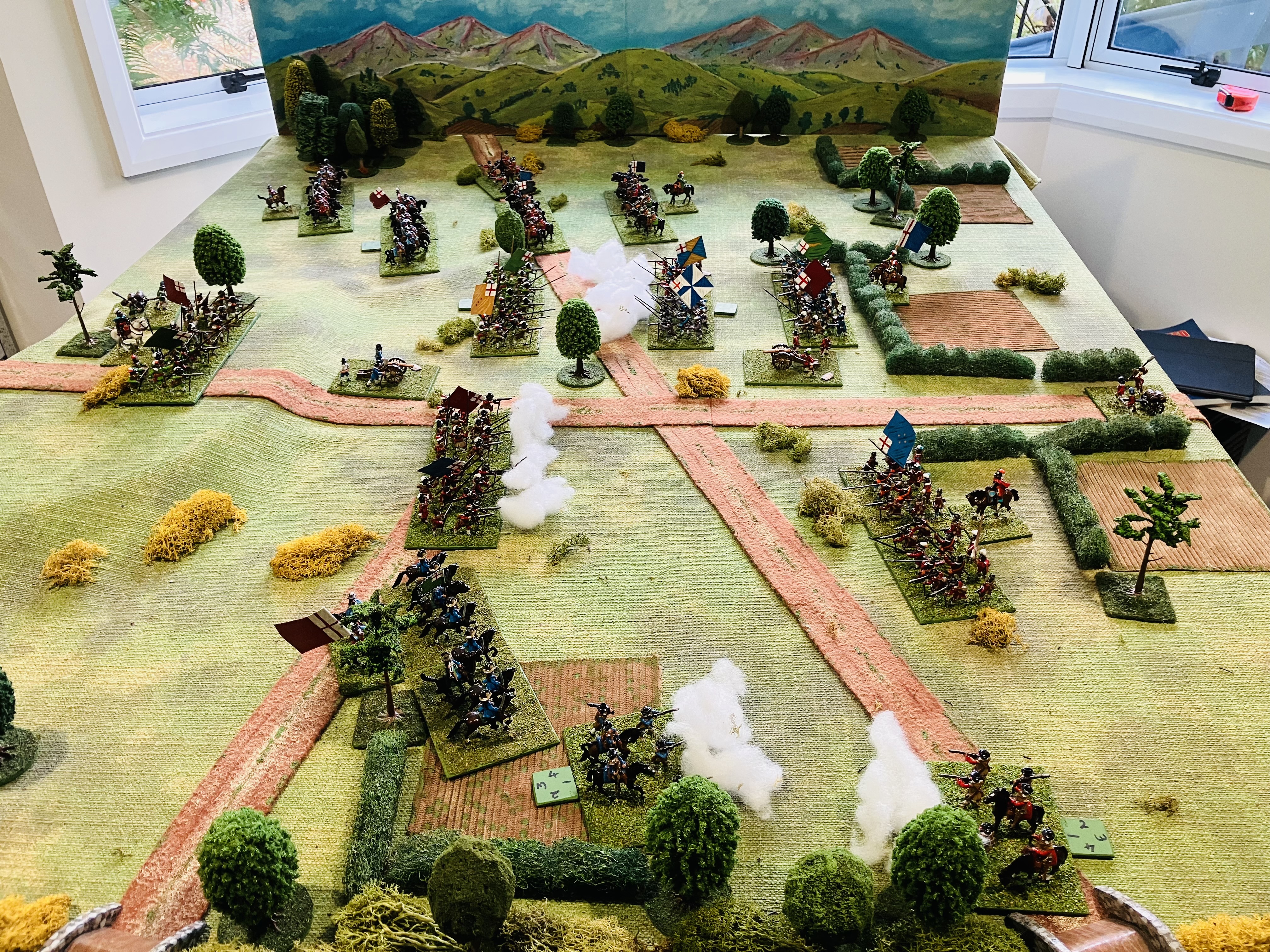
Infantry engage in the centre.

The tabletop layout was decided by terrain cards drawn from deck. A little bit more on using terrain cards can be found here. The Royalists had to deploy first followed by the Parliamentarians. I should have allowed Parliament to select the tabletop side, and only realised later in the game that I had forgotten.

Terrain cards are used to determine the tabletop layout.

The tabletop is setup and armies deployed.

The pre-battle actions had influenced the make up of the chance cards for each army. The Royalists having one extra rally card, while the Parliamentarians force had replaced a confusion card with a panic card. See the previous post for details about the cards.

Chance cards for the Royalists. One card is drawn and actioned at the start of the Royalist player’s turn.

Parliament’s chance cards. The cards are just cut out from a sheet of cardboard from the local craft store.

Order of Battle

There is little difference in the armies. The Royalists has an additional cavalry unit, while Parliament has an additional infantry unit.

Royalists:
  • 4 x Cavalry
  • 3 x Infantry
  • 1 x Artillery
  • 2 x Dragoons
Parliament:
  • 3 x Cavalry
  • 4 x Infantry
  • 1 x Artillery
  • 2 x Dragoons

Opening moves along the river

The Royalist forces, led by Sir Charles Blackthorne, began by advancing on their right flank beside the river, committing both their cavalry and dragoons to the attack. In response, Sir Nathaniel Cleve, commanding the Parliamentarian army, countered by pushing forward his left flank cavalry and advancing his infantry in the centre where he had an advantage in numbers.

After an intense struggle, the Parliamentarian cavalry gained the upper hand, routing their Royalist counterparts. However, their success was short-lived as they were caught in a withering volley from the nearby Royalist dragoons and scattered in disorder.

The opening action was along river.

Parliament’s first success with their cavalry was short-lived as their cavalry, disorganised after the clash with Royalist cavalry, were scattered by accurate musketry from dragoons.

The centres clash

Sir Nathaniel Cleve continued to advance his centre, pushing the leading infantry line forward while repositioning his second line to cover the gap left by the routed cavalry near the river. Both centres engaged in a short exchange of musketry before running out of ammunition. Meanwhile, Parliament’s right-wing cavalry began a cautious advance.

Fortune favoured the Royalists. Their centre-right successfully broke the opposing Parliamentarian infantry after a panic in the ranks, leaving Cleve’s left flank dangerously exposed. Sensing an opportunity, the Royalists committed their reserve cavalry, moving them up on the right to exploit the situation.

Meanwhile, on the opposite flank, the cavalry of both sides were locked in a fierce struggle with neither side able to gain the upper hand.

The infantry centres advance.

Royalist reserve cavalry move along the river as Parliament reposition their second line of infantry.

The flanks

After a prolonged and hard-fought melee on the Royalist left flank, their cavalry at last gained the upper hand, routing the Parliamentarian horse. After regrouping they wheeled inward, threatening the exposed flank of Parliament's centre.

Seeing the futility of continued resistance with Royalist cavalry now pressing both flanks. Sir Nathaniel Cleve ordered a general retreat.

Victory at the Battle of Raventon Crossing belonged to Sir Charles Blackthorne and the Royalist cause.


A hard fought cavalry action on the other flank sees the Royalists about to prevail.

Cavalry threaten both flanks of Parliaments centre, forcing them to retire.

Wrap up…

Parliament had a few moments of success during the game but was unable to capitalise on them. In contrast, the Royalist successes aligned well with the drawing of chance cards, as Parliamentarian units faltered in panic or Royalist units seized the initiative with well-timed free actions.

The pre-battle activity provided some variation to the game and helped with the narrative context. I plan to use it again, though I feel it could benefit from a little further work, for example, could tabletop objectives be added into the mix?

OHW Rules Variations

I used a variation of the One-Hour Wargames (OHW) rules for this game. Some of the changes include:

Dragoons and artillery are represented by single bases and are eliminated after taking 8 or more hits, half the threshold of the two base infantry and cavalry units, which are removed after 15 hits.

Dragoons and artillery musket fire uses a D6-2 and must test for running out of ammunition. 

All shooting units test for Out of Ammunition. Instead of rolling a separate D6 to test for out of ammunition, I check their shooting roll. If a 5 or 6 is rolled, the unit is considered out of ammunition. (Trotter cavalry cannot be resupplied with ammunition if the resupply chance cards is drawn.)

Movement is subject to friction. At the start of the movement phase, a die is rolled. On a result of 1, the movement phase ends immediately for that side. Units can still shoot.

Armies have 1 to 3 commanders assigned to the centre and wings, as well as a general. Each is attached to an infantry or cavalry unit and they have benefits in hand-to-hand combat.

In hand-to-hand combat, a unit with an attached commander rolls two dice and selects the higher result. If a double is rolled, the commander is wounded or killed and removed from play; the unit then reverts to rolling a single die in future combat.

All musketry and charge moves are limited to a range/distance of 6 inches.

Next up

The tabletop is returning to a sci-fi theme and is being prepared for a remote game using a square grid.

Preparing for a sci-fi game.


Monday, 11 September 2023

A couple of games this past weekend.

In addition to painting a few miniatures this weekend past, including additional Ashigaru and some English Civil War dragoons, I was also able to play a couple of samurai Sengoku period games with my Red clan and Blue clan samurai armies. Using an online translator, I believe their names are Akai ichizoku and Ao no ichizoku. For the games I selected the “surprise attack” scenario from One-hour Wargames, with 7 units per side instead of the standard 6 units. The first game was played on a 4x4 foot tabletop setup.

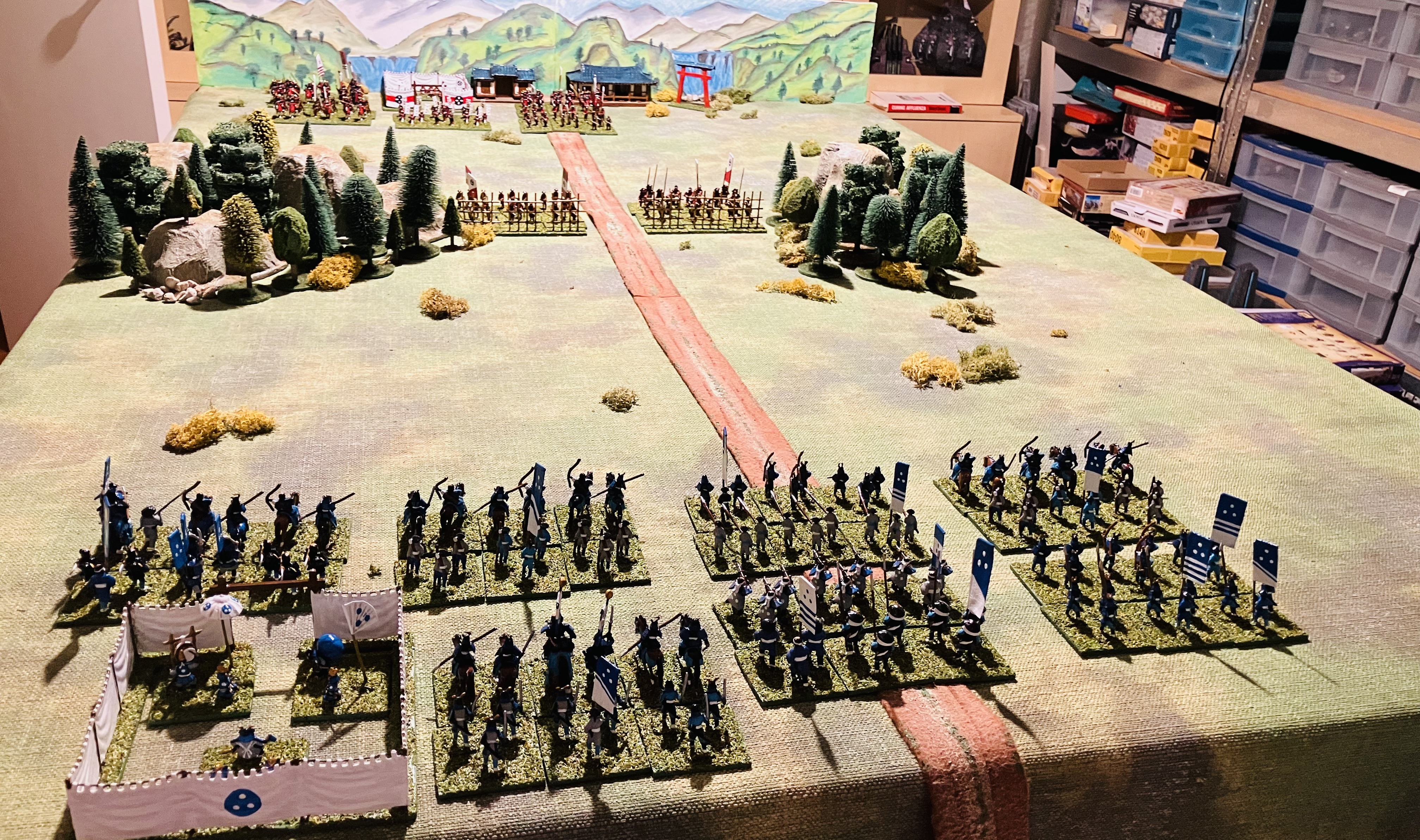
The scenario set up on a 4x4 tabletop.

The defenders are well prepared.

The games gave me an opportunity to get my recently painted headquarters encampments onto the tabletop and to test out some different chance cards that reflect the period and add a bit of flavour to the games. One of these cards is called "Personal Challenge," which allows a unit to issue a personal challenge to an enemy unit. When played, the enemy unit selected is inactive for its turn, it also cannot be attacked by any other unit. I had read that samurai, even in this late period, would use personal challenges, their objective along with any personal glory was to delay attacks or buy time to retreat. I have two of these chance cards in a player’s deck of 15 cards.

I found that the “Personal Challenge” cards added a new and themed twist to the game. It allowed me on a couple of occasions to protect my units when moving up for an attack and also to delay an enemy advance.

A personal challenge is issued.

The delay caused by the personal challenge stopped half the defenders shooting in the first game.

When I replayed the scenario a second time I decided to play length-wise down my 6x4 foot tabletop with the centre 4x4 foot of the tabletop being setup as per the scenario with a reserve area of 1 foot for each army’s base edge where I can place the headquarters encampment and any troops yet to arrive.

The scenario is set up in the centre allowing the reserve space to be set up with troops arriving later in the game.

The “surprise attack” scenario. Setup length-wise down the tabletop. The bulk of Red Clan is encamped near a town at the far end, unaware of Blue Clan’s imminent attack. It will take a while for them to be warned and organised to join the battle.

The attack well underway having forced the first line of defence.

The mountainous and wooded terrain of Japan played an important role in samurai battles. Strategic positions, such as bridges, castles, and mountain passes, were often fought over by samurai armies. This provides plenty of opportunity to use quite a few of the scenarios from the One-Hour Wargames book in a short campaign.

Sunday, 20 August 2023

Chance cards and a Samurai game

I am continuing my messing around with chance cards and using a slightly different approach for a Samurai game set during the 1550-1615 period. The rules used are a One-Hour Wargame variation and can be found in one of the links at the top of the blog.

A samurai game in progress.

In my previous post I described a method for using chance cards in wargames. Each player has 8 negative chance cards and 8 positive chance cards. Players shuffle their negative chance cards, then draw 5 of them unseen. They do the same with their positive chance cards. These cards are then added to the 5 "no event" cards and shuffled to create each player's chance deck. This method creates an element of uncertainty about the types of good or bad luck a player could experience, rather than having a known set of fixed events.

For the samurai game, I decided to use a slightly different variation of the above approach. Each player can select 8 cards from the following list, but no card can be selected more than 4 times:

Initiative: A free action for one unit to move, shoot, charge, or a round of hand-to-hand combat.

Rally: One unit can remove D6 hits.

Feint: One unit not within 12 inches or line of sight of an enemy unit can have an unlimited move, but can never move within 12 inches of an enemy unit during its movement on the tabletop. This makes skirmishing units particularly useful to block surprise appearances of a unit on the opposite flank or exposed flanks.

The limit of 4 cards helps to create a variety of cards, but allows players to gear their selection to suit their planned tactics for the game. Stacking the deck so to speak. For example, if defending, they may well choose 4 rally cards and a couple of feint cards to enable counterattacks, with the remaining 2 cards being made up of initiative cards.

The 8 selected cards are shuffled and 5 cards are drawn unseen by the player. These 5 cards are added unseen to 5 "no event" and 5 negative cards (which are fixed) and shuffled to create a player's chance card deck for the game.

A balanced 3 initiative, 3 rally and 2 feint cards are selected

The 8 selected cards are shuffled and 5 selected unseen and the remaining 3 discarded, again unseen by the player. All the positive, negative and “No event” cards are then shuffled and become the player’s chance card deck.

The Game…

The game has Blue and Red armies positioned on hills facing each other. Both armies are trying to capture the opposite hilltop or eliminate the enemy by reducing their number to 1 unit.

Tabletop setup with the two chance card decks in the foreground.

The orders of battle use 7 units because I am only using only 3 units types. This allows for a unique variation for each score on a dice.

A random force selection table

Order of Battle…

Blue Army:

  • 3 x Samurai units
  • 1 x Samurai Skirmisher unit
  • 3 x Ashigaru units

Red Army:

  • 4 x Ashigaru units
  • 2 x Samurai units
  • 1 x Samurai Skirmisher units

Note: in the photographs the samurai skirmishers have 4 bases a mix of mounted and foot bowmen, while the other samurai unit have 6 bases with a mix of mounted samurai and foot samurai with swords and pole arms.

A Brief Battle Report…

The battle commenced as the Red forces initiated an advance, directing their Ashigaru units forward along their right flank. Simultaneously, on the opposing flank, the Blue army moved forward, deploying their skirmishers and samurai. The Daimyo leading the Blue forces then chose to advance in the centre. At this phase of the battle, both sides engaged in ranged combat, employing their muskets and bowmen. Blue then executed a feint manoeuvre by transferring a samurai unit from their right flank to the left, reinforcing an assault on Red's right flank, which had been gradually gaining the advantage.

As the centre of the Blue forces began to waver, the Daimyo of the Red army made the decision to push forward with their central units while repelling the flanking threat posed by Blue’s samurai. The centre of the Blue army began to crumble, prompting some units to retreat towards a hilltop position with the aim of  establishing a final defence. Despite their battered state, the Blue forces managed to rally and effectively withstand Red attacks. The battle outcome was an honourable draw.

Red Ashigaru push forward on their right flank.

In the centre both forces exchange fire.

The switch of a Blue samurai unit to the opposite flank creates a threat for Red forces to deal with.

Blue’s centre has collapsed and the remaining forces retire to defend the hill.

Blue forces recover sufficiently to hold the hilltop and achieve a draw.

I found the game enjoyable using this method of choosing favourable cards and stacking the deck to align with the tactics planned for the battle. Building upon this approach, I am planning to create a set of predetermined card combinations, each consisting of 8 cards. These combinations will be based on the various historical battle formations, using their poetic name, such as "Ganko - Birds of Flight." Additionally, these prearranged selections will have specific restrictions regarding the deployment of units, adding a layer of constraint to the gameplay and battle narrative.

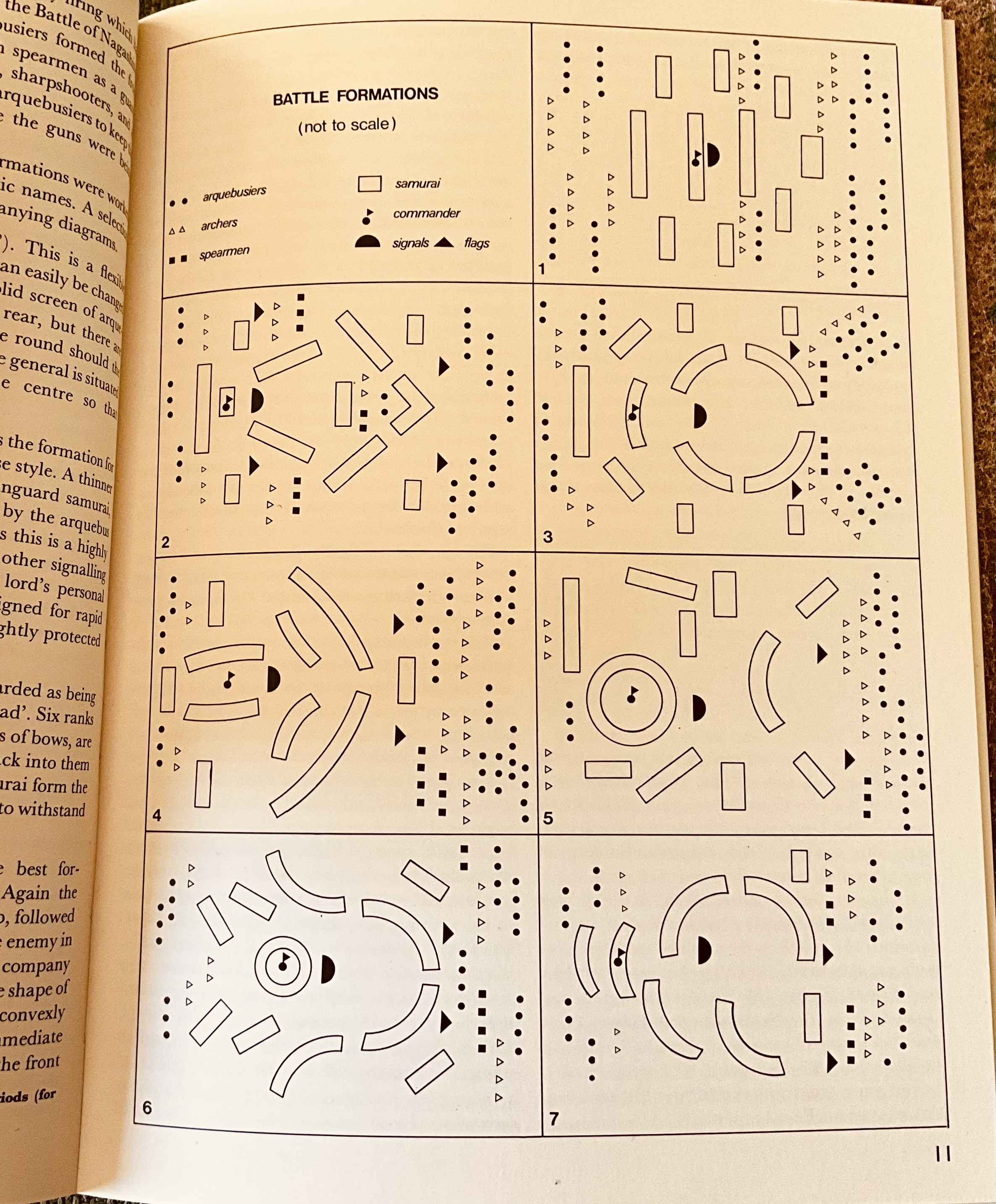
Battle formations

The formations were found in this book.

I think there will be a samurai campaign soon. Anyway that is all for now and I can ponder the campaign while gardening. There are just too many chores to do in the garden after being away and some recent wet wintery weekends.

Sunday, 13 August 2023

Playing around with chance cards

Wargaming activities were limited this past week due to a trip to Wellington, New Zealand, with the wife to catch up with our adult children and celebrate a birthday. While waiting at the airport and travelling on the flight I was thinking about the use of chance cards in my wargaming. I do enjoy using using chance cards in my wargames whenever possible as a means to easily add friction and uncertainly to my solo gaming. My go to approach for using chance cards is from "One-Hour Wargaming" by Neil Thomas, where a chance card is drawn during each player's turn. (As an aside the cards also help me track the game turns.)

A medieval game setup with the chance card decks for each player in the foreground.

A chance card is drawn by each player at the start of their turn. The cards are divided into three categories:

  • 5 neutral “no effect” cards that have no impact on the game.
  • 5 negative cards that introduce unfavorable effects to a player.
  • 5 positive cards that provide advantageous outcomes for a player.

A player’s chance cards

A typical set of chance cards will have:

  • 5 x no effect on the game
  • 2 x initiative cards that enable an addition action
  • 2 x rally cards to reorganise an number units
  • 1 x enemy panic card which causes hits to be applied to an enemy unit
  • 2 x no ammunition cards that limit the number of units shooting
  • 2 x confusion cards that limit the ability to move units
  • 1 x panic card where a friendly unit must take additional hits

However, one of the challenges of using chance cards is as the game progresses one can soon determine the likelihood of good or bad events occurring, and what they may be, based on the cards that have already been drawn from the player’s chance card decks. 

While waiting around doing nothing at the airport, I was thinking through some different ways to address the predictability of the cards as the game progresses, while keeping the balance between players. To help minimise the ability to predict cards I landed on this approach and tested it out this weekend. 

Step 1 - Add additional positive and negative cards to the player’s chance card deck.

Each player as 8 negative chance cards and 8 positive chance cards. Essentially I just added 3 extra cards one for each type of event described on the chance cards. Players shuffle their negative chance cards, then select 5 cards taking care not to see them. They then do likewise with their positive chance cards. These cards are then added to the 5 “no effect” cards and shuffled to create their chance deck. Repeat the above to create the other player’s chance card deck.

Step 2 - Shuffle the positive cards and discard 3 leaving 5 cards. Do the same with the negative cards. Then combine the 5 positive, 5 negative, and 5 no effect cards into one deck and shuffle. 

This approach provides both players with equal distribution of negative and positive changes, but they cannot be sure of the type of change. Having played a couple of games I am quite tempted to add a “no effect” card into each group of 8 positive and negative cards so there would be chance of only having 4 otitides or negative cards. This will create unbalanced chances for players, but nothing too drastic.

Another photo of the game to wrap up.


Saturday, 7 January 2023

Chance cards and a few modifications

As a mainly a solo wargamer I will often use on chance cards to add a level of unpredictability into my wargames. Most of my games use One-Hour Wargaming (OHW) rules or a variant of those OHW rules. So when I started to introduce chance cards into my games, I went with the suggested chance cards in chapter 22 of One-Hour Wargames by Neil Thomas. Where both armies have an identical deck of 15 chance cards comprised of: 5 beneficial cards, 5 adverse cards, and 5 no effect cards.

Chance cards

When beginning my 2nd Punic War campaign I wanted to somehow show the differences between the opposing armies. The obvious approach would be to add additional factors to the rules for each army and try and deal with the resulting rule complications. This was not really a path I wanted to take with the rules, as I like simple rules, so I opted to use different chance card decks for each army to reflect the attributes of the army represented. For example:

The Roman army with its legions were well organised and disciplined, but not always well led, particularly in the early stages of the campaign. So the Roman chance card deck is adjusted by:


  • Replacing a No Ammunition card with a Confusion card to represent the poor leadership and the good organisation of the armies by not having them run out of ammunition as frequently. 
  • Replacing an Initiative card with a Rally card to represent the solid and well disciplined troops lacking leadership.

Full details of the approach used in the campaign can be found in the link below.

https://gridbasedwargaming.blogspot.com/2021/07/ancients-campaign-turn-1-game-3-battle.html

A Samurai game underway using chance cards

Because I had enjoyed gaming using different army chance card decks for my Ancient games, I wanted something similar for my Samurai games using a variation of OHW Pike and Shot rules. I have included the draft rule variation in the tab at the top.

The differences between samurai armies of the Sengoku period (1467-1615) which I am wargaming was not a lot. So the question is - what would differentiate the chance card decks between armies

I looked around at other options and read about how generals of armies would adopt certain tactical formations and adapted them to the situation they found themselves in. These tactical formations were given names to reflect their use and how they looked when deployed.

A few of the tactical formations from “Samurai Armies 1550-1615” by S.R. Turnbull.

The names are quite poetic, Here are some examples:

  • Kakuyoku (“Crane’s Wing”) - Used to surrounding at army.
  • Ganko (“Birds in flight”) - A flexible deployment which can be changed as the situation unfolds
  • Saku (“Keyhole”) - a defensive deployment to be used against a fierce charge.

With 6 units per side in OHW games these tactical formations are not going to be easily adopted, instead the formation chosen reflects the tactics used with an emphasis on: attacking with movement cards, defensive posture with rallying cards, or blunting attacks with arquebuses and having sufficient ammunition supplies.

This should provide some period flavour to the rules. Sticking with a deck made up of 15 cards, one card for each turn, a player selects 6 tactical cards determined by the tactical formation (or approach) taken. These 6 cards will be added to a deck comprising of:

  • 6 x Tactical cards (selected)
  • 4 x Chance cards (with adverse conditions for an army)
  • 5 x No effect cards

For the games each army selects from a table of 7 tactical formations. Each tactical formation comes with a combination of 6 tactical cards. The table is presently limited to 7 choices. This is because I wanted a minimum of 1 type of tactic card selected and never allow more than 3 tactical cards of a particular type. I may change this in the future after playing some more games.

Tactical Chance Card Table

Once the associated tactic cards are added to the chance card deck along with the 4 chance cards and 5 no event cards. Both player’s decks are shuffled and placed face down ready for one card to be drawn at the start of each turn.

The 4 chance cards I am currently using to add adverse outcomes to the deck are:

  • 3 x Fog of War - Only D3 units may move or shoot during your turn.
  • 1 x Changing Loyalties - 1 non-skirmish unit takes D6 hits.

A samurai game in progress

Using this process for creating a chance card deck allows players to partially influence the game, or maybe their luck.

I do have generals in the game who are assigned to a foot or mounted samurai unit. In the event of the general’s assigned unit being eliminated, any tactical cards drawn are treated as no effect cards.

As the photographs suggests I now have my Samurai armies on the tabletop.