Sunday, 11 August 2024

Making Terrain for a Stompy Robot and Mech Game

In March 2024, I posted an update about my Stompy Robots and Mech Mayhem project. This weekend, I revisited the project to try and make some buildings that have the look of towering mining and manufacturing facilities. I wanted for a futuristic look and decided on tubular-shaped structures. This choice allowed me to put to use the various pieces of wooded dowel I've been saving in the shed, waiting for the right project.

Futuristic buildings for the robots and mechs.

Robots defending the mining and manufacturing facilities.

After deciding on tubular-shaped buildings, the next step was figuring out how to make them and choosing the colours. I wanted to make the buildings in such a way so they could be placed together to make one large facility. I also knew I didn't want the usual grey, so I chose a pale purple with blue undertones.

The first step was to cut up the wooden dowel into various lengths. I used the largest piece of the dowel as the base and piled the smaller pieces on top, glueing them as I went.

The wooden dowel cut up and glued together.

The buildings were first undercoated with white gesso, followed by a light grey. Once dry, I gave the buildings a pale purple wash, then used a blue wash to highlight specific features and the base of the buildings.

After undercoating a pale wash is applied.

A blue wash is added to highlight areas of the buildings.

The final step was adding details and sealing everything with PVA glue. I kept the details simple, using small dots of white and yellow, along with a few black lines.

The buildings with details painted on.

A closer look at the finished buildings.

With the buildings finished, the last task for this project will be to add some color to the gaming mat, which is currently just a piece of sand-coloured felt.

Tuesday, 6 August 2024

New book on solo wargaming arrived

I had been eagerly waiting for the book "Solo Wargaming - A Practioner’s Guide" by David Heading to arrive in the post. It arrived a couple of weeks ago and I have been able to find time to quickly read it. So here is my review of the book after a first read through.

I enjoyed the author’s writing style along with how the book is organised as it explores the various aspects of solo wargaming, offering guidance, suggestions and examples.

The new arrival from Pen and Sword Publishing

Chapter 1 addresses the question of why one might choose to solo wargame, examining both the advantages and disadvantages.

Chapter 2 looks the different types of tabletop battle settings, including historical, semi-historical, scenario-based, and fictional. It was good to see a variety of game types considered, such as role-playing, skirmishes, small to medium-sized games, and large wargames. The chapter also covered generating terrain, choosing forces, and generalship, discussing options for playing both sides or using an automated general. Each area discussed has practical advice and often one or two example mechanisms. The chapter concludes with a quick discussion on how to address biases towards armies, one’s favourite units, and reading/information sources.

In many ways, Chapter 3 (Campaigns) and Chapter 4 (Personalities, Logistics, and Randomization) form the core of the book, emphasizing how a campaign setting and narrative can significantly enhance the interest of tabletop battles and influence the decisions made during these games. These chapters delve into the scale and scope of solo campaigns and provide guidance on setting them up, and looks at the various types of campaigns, such as narrative, map-less, semi-mapped, and fully mapped. Even diplomacy gets a look in with an example mechanism, very useful for campaigns with more than two forces. The challenges of taking campaign situations to the tabletop and back again is well covered. There is a discussion on when and how to abstract campaign detail so to avoid getting bogged down in a campaign.

It was nice to see consideration given to siege, naval and air wargames in their own chapter 5 and how they can be incorporated into campaigns, or be a campaign in their own right.

The final chapter, Chapter 6 - Advancing, includes some additional considerations such as sources of inspiration, levels or realism and choices about abstracting them, and a few suggestions and guidance for approaching Sci-Fi and Fantasy.

So, what did I gain from reading this book? I found the emphasis on narrative particularly interesting, especially in the context of campaigns. This approach helps the story telling aspect of the campaign and adds personalities into any decision-making. Most of my solo campaigns have been about connecting a series of tabletop games with minimal record-keeping, so this narrative focus has given me something to think about and consider using for my future campaigns to add to their story. The chapter on handling sieges has some useful ideas and mechanisms which I can see myself using in some future campaign.

A book I am pleased to add to my wargaming library.

Saturday, 3 August 2024

Game Report - Battle of Cheriton 1644

Yesterday, I hosted a remote Battle of Cheriton wargame with Jon (Palouse Wargaming Journal). This battle from the English Civil War took place on March 29, 1644. Jon chose to play as the Royalists to see if history could be reversed. The preparation for the game is covered in my previous post and there were a couple of changes to the scenario discussed below).

Order of battle…

Parliament

  • Right Wing Command - 4 x Cavalry units
  • Left Wing Command - 3 x Cavalry units
  • Centre Command - 6 x Infantry units
  • Reserve Command - 2 x Infantry units
  • 1 x Artillery units
  • 2 x Dragoon/Commanded Shot units

Royalist

  • Right WIng Command - 4 x Cavalry units
  • Left Wing Command - 3 x Cavalry units
  • Centre Command - 5 x Infantry units
  • Reserve Command - 2 x Infantry units
  • 1 x Artillery units
  • 3 x Dragoon/Commanded Shot units

Tabletop Setup…

The tabletop setup has the woods on one flank and a series of fields and hedges in the centre. While the fields do not affect combat, the hedges remain in place. I do not allow hedges to be moved or for units to end their move positioned precariously on top of them. This approach means formations can become disrupted, and this can sometimes prevent units from supporting friendly units or engaging enemy units. Only dragoons or commanded shot can occupy wooded areas.

The tabletop setup.

All units are deployed on the tabletop at the start. The game begins with Royalist dragoons and commanded shot successfully occupying the woods, while an infantry unit advances on Parliament’s left wing. Initially, I considered having a rule where the woods would be contested first before either side could advance their main force. If the Royalists secured the woods, an infantry unit would then advance. However, after a few test games I decided the simplest approach was to start the game with the Royalists already holding the woods and an impulsive Royalist infantry unit positioned advancing on the Parliamentarian left wing, as it appears to have occurred in the historical battle.

The deployment of commands with the Royalists occupying the wood and one impulsive unit advancing.

Opening Moves…

The Parliamentarian cavalry quickly targeted the advancing Royalist infantry, charging them with their left wing cavalry while also advancing their infantry centre. This situation prompted the Royalist right wing cavalry to charge forward and engage Parliament's cavalry, they were supported by their left wing cavalry who moved around from behind the Royalist centres. The battle soon intensified the with infantry centres of both armies advancing and engaged in combat.

The Royalist cavalry quickly gained the upper hand in the engagement, prompting Parliament to advance their right wing cavalry command from their position behind their centre provide support and plug any gaps.

Parliament’s cavalry charge the impulsive Royalist infantry unit.

The cavalry clash on the wings while the infantry in the centre have advanced.

Middle Game…

The battle was quickly becoming a slog in the centre, and as casualties mounted, Parliament gradually gained the upper hand, prompting both armies to advance their reserve infantry. On Parliament’s left wing, their supporting cavalry initially nullified the attacks from first line of Royalist cavalry but soon faced renewed pressure as the Royalist second line charged in.

The second line of Royalist cavalry move up in the background, while the centre the battle is intensifying.

Parliament is gaining an advantage in the centre, while their cavalry on the left wing is hard-pressed.

End Game…

The Royalist cavalry finally defeated most of the opposing Parliamentary cavalry, opening up the flank. In the centre, a sizeable portion of the Royalist line routed from the pressure from Parliament’s infantry. The Royalist reserve infantry braced themselves for the advancing enemy infantry, but the advance did not eventuate. After losing more than half of its units, many of them cavalry, Parliament chose to call off the battle and retire in good order.

The battle in the centre intensifies, while on the flank Royalist cavalry have gained the upper hand.

The Royalist centre outs, but too late for Parliament who have more than half of their army routed.

Summary…

Well done to Jon for his victory, who’s infantry effectively held up my centre attack long enough until his cavalry eventually prevailled.

The losses in the game were:

Royalists:

  • 5 x Infantry units
  • 4 x Cavalry units
  • 2 x Commanders

Parliament:

  • 3 x Infantry units
  • 6 x Cavalry units
  • 1 x Artillery unit
  • 1 x Commander

The game was decided using a points system, which I’m still fine-tuning:

  • Add 1 point for each routed enemy unit.
  • Add 3 points for each enemy supply unit attacked.
  • Add 2 points for each enemy commander lost.
  • Add 3 points if the enemy commander-general is lost.
  • Add 6 points if enemy army is reduced by more than half, including any enemy cavalry exiting the tabletop after attacking supplies.
  • Add 6 points for each objective captured.

Using this system, the Royalists scored 18 points (10 for enemy units routed, 2 for an enemy commander removed from play, and 6 for reducing enemy units by more than half). Parliament scored 13 points (9 for enemy units routed and 4 for enemy commanders removed from play).

If you’re wondering why both armies were slow to advance their reserve infantry and second lines of cavalry, it’s because the rules limit movement to only two army commands per turn. This restriction prevents frantic manoeuvring of units and ensures a more gradual engagement of commands as they advance.

This was a most enjoyable game, taking just over an hour and a half to play. In a couple of weeks, Jon will be hosting his version of the battle and we will be using his rules.

Saturday, 27 July 2024

Remote Game Preparation - The Battle of Cheriton 1644

In the coming week, I have a remote English Civil War game planned with Jon from Palouse Wargaming Journal. Jon suggested that we play the battle twice, once with me hosting and then with Jon hosting. We've used this approach before with the Battle of Lake Tresimene (see here and here) which proved a very interesting comparison and enjoyable.

A view of the Royalist units

This time, the battle was selected from the English Civil War, the Battle of Cheriton (1644) picked from one of the scenarios in C.F. Wessencraft’s book “With Pike and Musket”. I plan to play the battle on a 6 foot by 5 foot tabletop, which allows nearly the entire battlefield to be visible from my mobile phone mounted on a tripod. It’s a simple and cheap setup for remote gaming, though it does limit the size of the game.

A view of Parliamentarian units

The Battle

The Battle of Cheriton, fought on 29th March, 1644 and was a Parliamentarian victory. Sir William Waller's force defeated a Royalist force commanded by the Earl of Forth and Sir Ralph Hopton. The Parliamentarian army had marched overnight and had occupied Cheriton Wood. Lord Hopton positioned the Royalist army on a ridge north of the wood. The battle began with the Royalists taking the wood and forcing the Parliamentarians to retreat. Hopton had then planned to defend, but an impulsive Royalist infantry commander attacked the Parliamentarian left wing. The attack failed and the Royalist cavalry were drawn in to supporting the attack, but were defeated. Hopton then moved his left wing cavalry to join the attack and they were similarly defeated. The Parliamentarians then counter-attacked, driving back the Royalist forces and regaining Cheriton Wood. As evening fell, the Royalists retreated.

The tabletop layout.

Order of Battle…

Parliament

  • 6 x Cavalry units
  • 8 x Infantry units
  • 1 x Artillery units
  • 3 x Dragoon/Commanded Shot units

Royalist

  • 6 x Cavalry units
  • 7 x Infantry units
  • 1 x Artillery units
  • 3 x Dragoon/Commanded Shot units

Scenario Rules?

This weekend, I plan to test the scenario and try out some rules. For example, Royalist units must attempt to capture the woods before any other units can advance. If they succeed in taking the woods, roll a D3 dice to determine how many infantry units make an impulsive double move towards Parliament’s cavalry.

The tabletop ready for a game.


Saturday, 20 July 2024

Remote Samurai Game

A day or so ago, I had the pleasure of hosting and playing a remote samurai game with Jon from Palouse Wargaming Journal. It had been quite some time since my last remote game, as other non-wargaming activities had been keeping me busy.

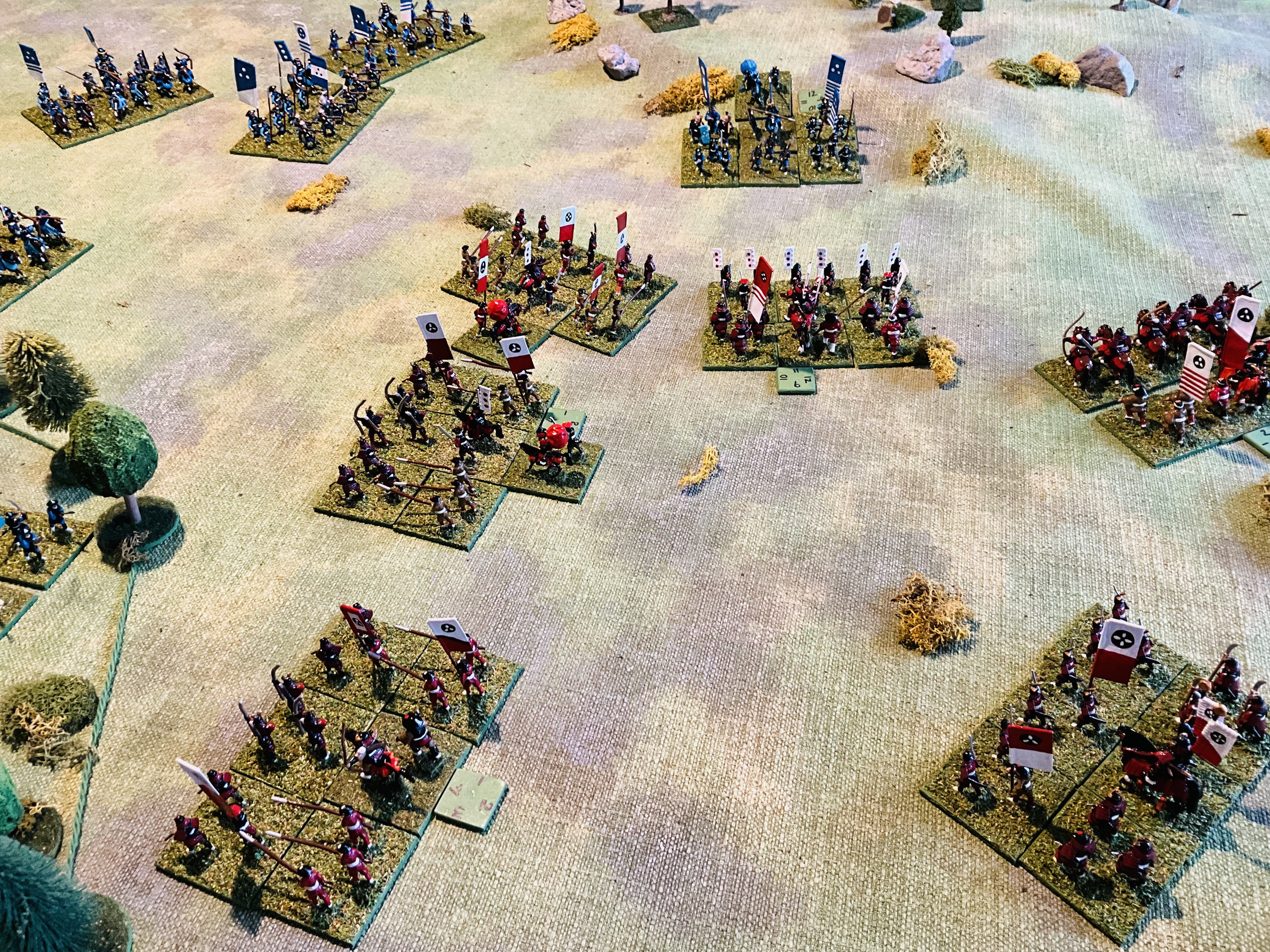
Early stages of the game

My remote gaming setup is quite basic, consisting of a mobile phone running the remote meeting and a camera attached to an extendable tripod. Generally, this works well since I limit the tabletop playable area to either 5x4 feet or 4x4 feet. This setup allows the tripod and mobile phone to cover the entire table from a set position, giving the remote player a good view. 

For the samurai game, I used a 6x4 foot area, which required occasionally moving the tripod so Jon, the remote player, could see all the action. As the game progressed and the armies closed in, the need to reposition the tripod was less. However, the tripod is not always stable when the mobile is extended up quite high to get more of a top down view, and there were a couple of times where the tripod toppled over, causing Jon to experience a virtual "face-plant" on the tabletop. Despite these hiccups, the larger table was manageable.

A cheap tripod and mobile are used for hosting remote games.

The game takes place during the Sengoku period, featuring a clash between two hypothetical clans. The Shinku (Crimson) clan had been relentlessly besieging a castle allied with the Ao (Blue) clan. In response, the Ao clan dispatched a relief force, which has secretly marched overnight and used the early morning fog to surprise the Shinku forces. As the fog lifted, both armies found themselves face to face, ready for battle.

The order of battle:

Shinku (Crimson) clan

  • 1 x Mounted Samurai (Hotomoto) with Daimyo
  • 2 x Foot Samurai units
  • 4 x Ashigaru units
  • 3 x Tsukai-ban
  • 1 x Command tent

Ao (Blue) clan

  • 1 x Mounted Samurai (Hotomoto) with Daimyo
  • 1 x Mounted Samurai unit
  • 2 x Foot Samurai units
  • 4 x Ashigaru units
  • 2 x Tsukai-ban

While the Ao clan outnumbers the Shinku clan, the overnight march left them poorly organised for battle. This disarray is reflected in their having fewer Tsukai-ban (messengers) and no command tent, resulting in a reduced chance of their units rolling for multiple actions when activated. Additionally, the absence of a command tent means their Tsukai-ban cannot be reassigned to other units.

Deployment

The Shinku clan must deploy all their units within the red zone. The Ao clan will deploy after the Shinku clan and can place units anywhere in the blue zone.

Map of the tabletop showing deployment zones.

Game Length and Turn Order

The Ao clan player always goes first in each turn. The game lasts until one army is reduced to two units.

Victory Conditions

Reduce the opposing army to two or less units.

Game Report

The Ao clan positioned their samurai on each flank, with their Ashigaru in the center and their mounted samurai and Hatamoto held in reserve behind the centre. The Shinku forces, on the other hand, formed two battle lines placed their Ashigaru in the front line and kept their all their samurai and Hatamoto units in a reserve line.

Opening moves of the battle with Ao samurai units advancing on the flanks.

Battle Report

The battle commenced with the Ashigaru units of both armies advancing towards each other. They were soon engaged in an exchange of arquebus fire. While the Ao samurai on the flanks advanced, entering the wooded area on their right and the hills on their left. 

Despite effective shooting by the Shinku forces, the Ao samurai on the flanks proved to be a real handful and threat. Their aggressive advances had disrupted the Shinku battle lines, forcing them on the defensive and causing one of their units to rout.

The Shinku are forced to retreat from the woods.

As the battle progressed, the Ao attack intensified, putting significant pressure on the Shinku army. In response, the Shinku forces advanced their samurai and Hatamoto units to counter the threat from the Ao flanks. Their Ashigaru in the centre continued to performed well, successfully routing part of the Ao centre. This forced the Ao clan to advance their mounted samurai and Hatamoto earlier than planned to maintain pressure on the Shinku centre.

The Shinku respond to the Ao samurai attack from the hill.

The Ao Hatomoto are engaged early plugging the gap in the centre.

The Shinku army having endured the Ao army’s attack, and despite suffering significant casualties, began a counter attack led by their Ashigaru. The Ao army having exhausted its strike force of samurai from their earlier assaults, were forced onto the defensive, and were eventually forced to retire from the field of battle.

A turning point in the battle as the Shinku forces reorganise to counter attack.

The Ao army having been reduced to two units retires from the field of battle.

Summary

Congratulations to Jon for his hard-fought win. The Shinku army did initially struggle with the Ao flank attacks by their samurai units, but were able to withstand them. In the centre their Ashigaru were effective, guided by the Tsukai-ban, and they wore down the Ao units with their shooting. This meant the Ao Ashigaru failed to inflict sufficient damage with their shooting for their mounted samurai and Hatamoto to launch an effective assault in the centre. A most enjoyable game.

For the game, we used my home-brew samurai rules. There are a few areas of wording I need to clarify and tidy up for my next game. The activations and use of Tsukai-ban seemed to function as the rules intended. Alas, there were no personal challenges during the game. I suspect we both forgot about that rule.

Sunday, 14 July 2024

Adding messengers to my samurai games

This weekend I was able to paint up a few more samurai messengers (Tsukai-ban) for my games to replace the tokens I had been using. These messengers played an important part on the Sengoku battlefield, translating the Daimyo’s orders into actions on the battlefield. Over the past couple of weeks I have been trying to incorporate Tsukai-ban into my samurai rules where they can have an influence on the actions a unit may take.

Tsukai-ban and a command tent.

My current rules have an activation approach where units are individually activated by a player during their turn. With each activation a D6 is rolled. The result determines the number of actions the unit can take:

  • On a score of 1, the unit fails to activate.
  • On a score of 2-4, the unit can perform 1 action.
  • On a score of 5 or more, the unit can perform 2 actions.

The unit then performs a number of actions based on the roll. All actions for the unit must be completed before the player activates another unit. Possible actions include:

  • Move (including charge by moving into contact with an enemy unit)
  • Shoot
  • Personal Challenge (with 2 actions)

Units with two actions can perform them in any order, such as: move and shoot, shoot and move, move twice, shoot twice, move and charge, or charge twice. Actions cannot be carried over or saved for later use.

A Tsukai-ban attached to a unit.

Tsukai-ban can be either attached to units or placed in the command tent, ready to receive their next orders. At the start of a player’s turn, before attempting to activate their units, they can move from the command tent to attach to a unit, or detach from a unit and move to the command tent. They cannot move directly from one unit to another; they must first return to the command tent.

A Tsukai-ban adds 1 to their attached unit’s activation D6 rolls, playing a crucial role in activating units and increasing the likelihood of a unit taking multiple actions and avoiding a failure to activate.

If the unit they are attached to is eliminated, then the Tsukai-ban is also eliminated.

If an army does not have a command tent, or the command tent has been eliminated by an enemy unit making contact, Tsukai-ban cannot move between units and must remain with the units they are attached to.

The messengers are the last piece to add to my samurai rules. I am now writing up all my notes after a number of enjoyable test games.

Monday, 1 July 2024

Adding personal challenges to the samurai rules

As I continue to work through my home-brew samurai rules, one of features I want to include are personal challenges (and heroic deeds). Even during the 1550-1650 period, the time period these rules are aimed at, samurai would occasionally issue personal challenges to their opponents. They were often employed as a tactic by retreating samurai units, hoping the time spent issuing, accepting, and fighting the challenge would allow them to either escape or reorganise themselves.

I wanted the rule mechanism to be easy and fun to use, and also provide variable outcomes. I opted for an approach using coins to decide the outcome, where coins are flipped by both participants with heads winning. Whenever the result is two heads or two tails, then another round of combat occurs. After each round of combat, unless killed, players can remove one of their unit’s hits as they reorganise or are inspired by the challenge. While this rule offers little to no benefit to fresh units, it can be advantageous for depleted ones that have accrued a number of hits.

Challenges are issued and accepted.

Below are the draft rules, followed by an example…

Personal Challenges (and Heroic Deeds)

The leader of a samurai unit must spend 2 actions to issue a personal challenge to an enemy samurai unit, whether on foot or mounted, within movement range. Challenges can only be issued between samurai units, foot or mounted.

When a personal challenge is issued, both players move their commanding samurai bases to an equal distance between the units to commence personal combat. The process for combat is as follows:

Combat. Both players flip a coin for their samurai leader, then compare on the table below. Heads will win unless the other player has also flipped a head.

Personal Combat Table

Combat Results. For each round of combat a samurai leader survives, remove 1 hit. When combat concludes, the winning samurai leader returns to their unit with their opponent's head, while the loser is removed from play.

Example of personal challenge combat…

Blue mounted samurai who have taken 7 hits are now facing off against Red’s foot samurai and Ashigaru. Wanting to delay until further reinforcements arrive they successfully roll 2 actions and choose to offer a personal challenge to the foot samurai who currently have 1 hit. 

The leaders of both units are placed equal distance between the two units.

The first round of combat has both flipping tails. So both will be able to remove 1 hit.

Blue flips a heads while red flips tails. Blue wins and can remove another hit, while red loses.

Blue leader returns victorious to their unit which now has 5 hits. Red leader is removed as a reminder they cannot issue a challenge. They have removed 1 hit for surviving the first round of combat.

All being well I hope to try these rules out in a couple of games over the next week. I will also be considering whether to add victory points to the game where personal challenge wins can add victory points.