Thursday, 5 December 2024

Matchbox Challenge - Battle Report (Part 4)

If you have been reading the past few posts on the development of a matchbox wargame, you maybe wondering how does it play with the rules. This post is a game report on an encounter between a couple of opposing ironclads as they patrol a tributary of the Mississippi River.

(For details behind the wargame in a matchbox challenge see the blogs Man of Tin and Duchy of Tradgardland.)

Ironclads steaming down the river.

Background

Two ironclads are patrolling the winding waters of Silverbend Creek, a serpentine tributary feeding into the Mississippi River. The Confederate ironclad, CSS Thunderforge, is working its way upstream under the command of newly promoted Captain Calder. Heading downstream is the Union ironclad, USS Resolve, commanded by the battle-hardened Captain Barrett.


The game setup CSS Thunderforge on the left and USS Resolve on the right heading down river.

Game Report

As the two ironclads round one of the many bends of Silverbend Creek, they come into view of each other. Both ships open fire with their forward cannons, but at long range, neither manages to land a hit. Undeterred, they both press forward, closing the distance to improve their shooting and to inflict damage.

USS Resolve shoots. A D6-1 and subtracts a further 1 for firing forward. A score of 2 means a range of 2 matchsticks as their gunnery falls short.

CSS Thunderforge’s shooting is just as poor as both ships close.

Eventually USS resolve scores a hit which causes crew casualties on CSS Thunderforge. They will no longer be able to affect repairs to their ship.

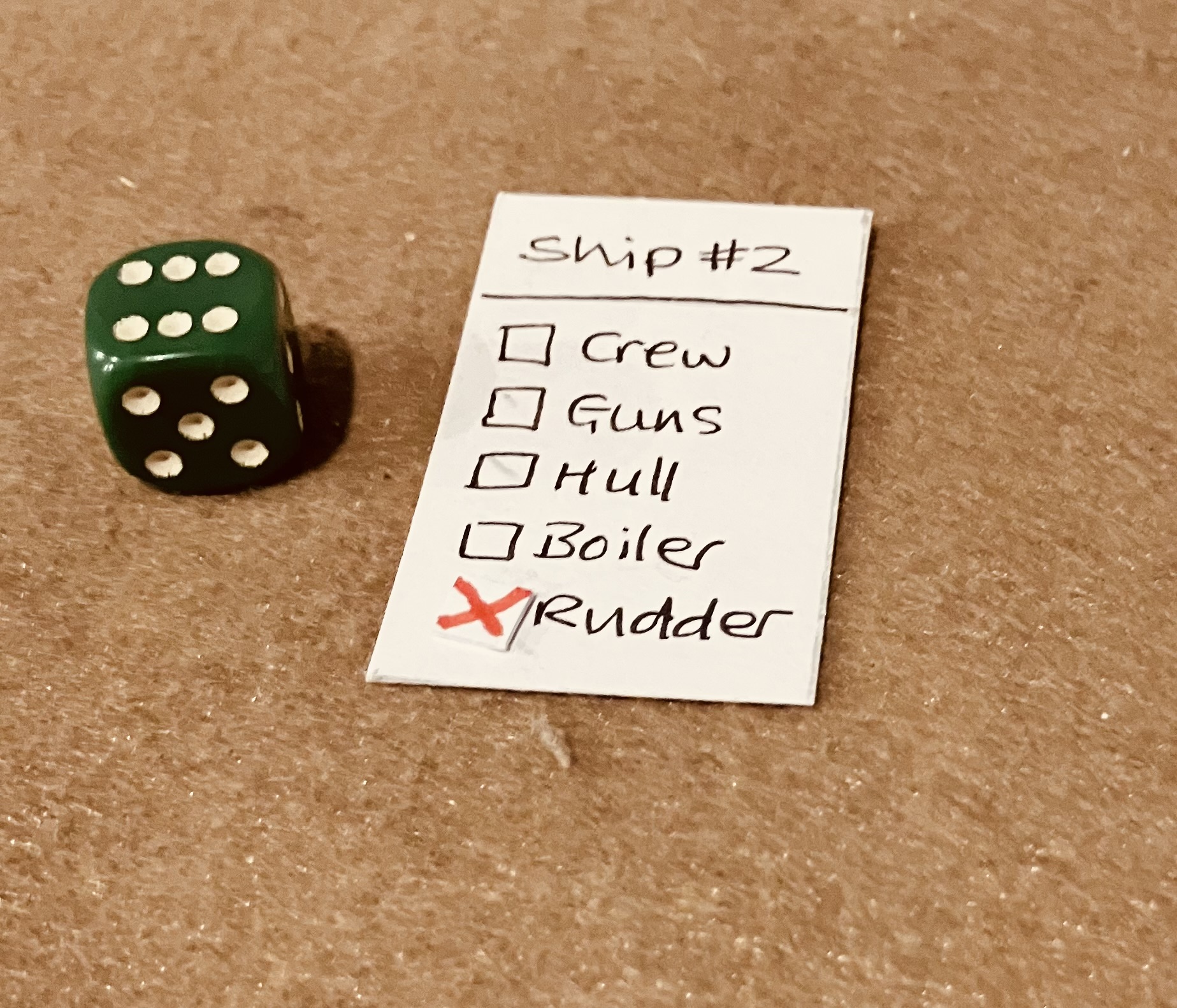
As the ironclads closed, the USS Resolve managed to ram the CSS Thunderforge, but the impact failed to inflict any further damage. The two ships pass each other and began turning around for another engagement. During the exchange, the USS Resolve sustained a well-aimed shot that damaged her rudder. However, her crew quickly sprang into action and successfully made repairs.

USS Resolve rams, but there is no damage.

On the damage table a second hit to the crew is ignored as the various ship areas can only be damaged once, unless they are repaired. However, crew casualties and hull damage cannot be undone in the repair phase.

USS Resolve has its rudder damaged. But with a full crew was able to later repair the damage.

As the battle continued, the USS Resolve landed several direct hits, damaging the CSS Thunderforge’s guns and boiler. Both crews by this time had suffered significant casualties, leaving them unable to carry out repairs.

Both ships turn to engage in battle again. USS resolve is now on the left and CSS Thunderforge is on the right.

CSS Thunderforge is suffering a number of hits and damage.

Leveraging her speed advantage, Captain Barrett on the USS Resolve orders another ramming attempt, which is successful, inflicting damage to the enemy’s rudder. Captain Calder, realising the severity of the situation, ordered his crew to abandoned ship as it slowly begins to sink.

A second ram by USS Resolve sees the enemy ship sink.

Wrap Up

The damage rules assign hits to various areas of the ship, such as the boiler, rudder, and hull, creating a more narrative approach to the game, rather than simply tracking damage until a limit is reached and the ship is eliminated. The rules allow the effects of damage to influence play, such as limiting movement if the rudder is hit or reducing speed when the boiler is damaged. While damage can be repaired providing there is a full crew, but crew casualties will stop repairs from being made. This approach helps with the storytelling aspect of the game, which helps create interest when there are only a small number of ships involved in a game.

Sunday, 1 December 2024

Matchbox Challenge - Drafting the Rules (Part 3)

This weekend, I have been drafting the rules for my wargame in a matchbox. I now face the challenge of somehow fitting them inside the matchbox without shrinking the text too much. However, before getting to the rules my first task was to create some hit markers to use with the ship status cards. They are small card squares 5x5mm with a Red Cross drawn on them, front and back so no need to worry about turning the fiddly things the right way up.

(For details behind the wargame in a matchbox challenge see the blogs Man of Tin and Duchy of Tradgardland.)

Matchbox contents. The rules are yet to be added.

Hit markers for use on the ship status cards to track damage.

A box contents list has now been added and stuck to the inside of the drawer. 

For the question of how to best to fit the rules into a somewhat full matchbox I may have an answer. The current solution (still a work in progress) is to see if I can make full use of the matchbox itself. By unfolding the box, I can write on both the inside and outside surfaces. To keep everything intact, I’m using some paper tape I made which slides over the outside to hold the box together.

The paper tape holding the matchbox together.

With the drawer removed the outer matchbox can be opened up and used to write the rules.

Draft Rules…

Since this game fits within a matchbox, it felt fitting to use matchsticks for the measurement of movement and shooting distances. I have now included five and a half matchsticks for this purpose. Below are the draft rules. I plan to use the inside of the matchbox drawer to sketch out how movement works, replacing the current photos I am using below.

ACW Ironclad Wargame

This is a matchbox wargame for playing riverine battles of the American Civil War on a flat surface of 2 by 1 foot. 


Game Setup

Lay the two lengths of string on the tabletop to represent the riverbanks, ensuring they are spaced between 4 to 5 matchstick lengths apart. Decide the direction of the river's flow and position the flow marker.


Sequence of Play

Each game turn is divided into the following phases:

  1. Movement and Ramming 
  2. Shooting
  3. Damage Resolution
  4. Repairs

Movement and Ramming

Ships move one at a time, starting with the one furthest upstream and proceed downstream moving ships.


On their movement turn, a ship has 3 choices:

  1. Stay stationary,
  2. Move half a matchstick length, or
  3. Move a full matchstick length.  

To move, place a matchstick touching the bow of the ship and facing straight ahead. Then slide the model forward so the stern aligns with the other end of the matchstick.


At the start of the move.

At the end of the move.


Turning - Ships moving half or a full matchstick length may turn up to 45 degrees at both the start and the end of their movement, pivoting at their centre. Stationary ships cannot turn.


Effects of Damage -  A ship with a damaged boiler can only move half a matchstick. A ship with a damaged rudder can only turn once, either at the start or the end of its movement.


Riverbanks and Sunken Ships - Any ships that make contact with a riverbank or sunken ship becomes stranded and immobile for the rest of the game.


Ramming - To ram, a ship can only turn at the start of its movement. If the ship makes contact with an enemy vessel, roll a die, consult the damage table, applying damage immediately. 


Shooting

Shooting is simultaneous and all ships get to shoot (even those engaged in ramming). The procedure is as follows:  

  1. Select Target - A ship may target only one enemy ship with a clear line of sight.  
  2. Range Calculation - Roll a die and subtract 1 to determine the shooting range in matchstick lengths. Apply the following modifiers to the score: -1 if shooting forward of the bow or rearward of the stern, and -1 if the ship has sustained gun damage.  
  3. Damage Resolution - If the target ship is within range place a hit marker next to the ship as a reminder they have taken a hit and need to resolve damage in the next phase.

Damage Resolution


When a ship is struck by shooting or ramming, roll a die and consult the damage table below:  


1 = Glancing Blow - No damage.  

2 = Crew Casualties - The ship cannot make repairs.  

3 = Hull Damage - Permanent; cannot be repaired.  

4 = Damaged Guns - Reduce all shooting rolls by 1.  

5 = Boiler Damage - Movement is reduced to half a matchstick.  

6 = Rudder Damage - The ship can only make one turn during movement.  


Record all damage on the ship's status card using the hit markers.


If a ship has already sustained damage to a specific area, no additional damage is applied to that area. For instance, if a ship with existing hull damage is struck again in the hull, the result is ignored. 


A ship with four hits begins to sink and can take no further actions for the remainder of the game. It remains in place as an obstacle to other ships.


Repairs


After all damage has been applied ships that are not sunk and have not taken crew casualties can attempt a repair. Roll the die and compare the score to the repair list:


1-3 = Repairs fail.

4 = Remove gun damage

5 = Remove boiler damage

6 = Remove rudder damage


A game setup and ready to play.


Thursday, 28 November 2024

Wargame Matchbox Challenge - Adding Contents (Part 2)

I am continuing the challenge to develop my wargame in a matchbox. The idea behind this fascinating challenge stems from a discussion between Mark and Alan on their blogs Man of Tin and Duchy of Tradgardland.

This week, I have added some new components to the game, riverbanks and a river flow indicator. The riverbanks are represented by pieces of string which can be easily laid out to define the course of the river. The flow indicator is made a card and is important for the game’s movement rules, where ships are activated one by one, starting upstream and progressing downstream until all ships have had the opportunity to move.

Adding some more contents to the matchbox.

A game in progress with the string representing the river banks.

A simple blue arrow is used to show the river flow.

Having opted for an American Civil War (ACW) ironclad game (see previous post) and having scant knowledge of the naval aspects of the ACW. I thought I had better do some reading so I purchased an ebook “Mississippi River Gunboats of the American Civil War 1861-65”.

Some reading to help with the game and provide ideas for the rules.

The current combat rules involve tracking hits to specific areas of the ships. To simplify the tracking of damage, I made a card for each ship where the damage can be marked with a pencil. These cards are designed to fit neatly into the bottom of a matchbox. However, I realised I will need to revise the cards in a way to make the game entirely self-contained in a matchbox, and not rely on the players having a pencil readily available.

Ship cards sized to fit into the bottom of the matchbox.

The next steps are to write up the rules to make sure they fit into the matchbox. The to hit and damage tables will be glued onto the outside of the matchbox to save space. The other idea I want to try out is making the draw of the matchbox into a fort for the game as they played important roles in the ACW naval campaigns.

Friday, 22 November 2024

Joining the Matchbox Challenge (Part 1)

Two wargaming blogs I enjoy following, Man of Tin and The Duchy of Tradgardland, have been discussing a design challenge to create a wargame that fits inside a standard matchbox. This concept interested their readers and they have opened the challenge to anyone, with more details available here. The concept of making a wargame compact enough to fit into a standard matchbox intrigues me, so I have decided to give it a try. Over the past week, I’ve been pondering ideas for the challenge while also making progress on painting my house (and I am happy to report it's now halfway done! The house that is, not my pondering.)

A 30mm long ironclad model steaming along.

Not having any of my wargaming and modelling equipment available means I cannot reuse any models, for example, a handful of 15mm figures for a skirmish game. So I decided I would have to create some models for the challenge, while not fully ruling out land games, this has pushed me in the direction of naval and air wargame ideas. Both have the advantage of not really having to include any terrain features into the game, any features required would take up valuable space in the matchbox. The matchbox’s dimensions (34mm x 55mm x 14mm) set the size constraints for the project. 

In the end I decided on a naval-themed game. The American Civil War riverine battles with ironclads seemed like a good choice because their blocky designs should be easier to make using materials like card, toothpicks, and Milliput epoxy putty. 

Four prototype ships have been built to fit within the matchbox and still leave room for a single D6 die, each ship is 30mm long. Having four ships will allow for a variety of scenarios such as one-versus-three escapes, late arrival of reinforcements, or straightforward one-on-one duels.

The half finished models in the matchbox with a small die.

The models are complete and just need a bit of sanding before being painted in a mix of dark grey and brown.

The next steps in this challenge for me, aside from finishing the models, are:

  1. Create some riverbanks and sandbanks using string, which can be coiled to fit inside the matchbox.
  2. Write some simple rules that fit on a small sheet of paper to fit into the matchbox (around half the size of A4 or Letter paper) or that can be cut up and pasted onto the outside of the matchbox.
  3. Design ship cards for each vessel, including their details and stats to support the rules.
The next post on this challenge will be about the rules where I plan to use the matchbox as a measuring tool for movement and ranges.


    Saturday, 16 November 2024

    Painting and rule changes

    Wargaming continues to take a back seat as pretty much every day I am driving to the house and spend my time painting rooms (not models alas). This gives me plenty of time to think about and ponder the mech rules. However, the downside is that when I do manage to fit in a quick game, I often have new rule changes I want to test, which is slowing down the progress of my mech campaign.

    A random mech photo made to look cartoonish.

    Rule Changes…

    I have tried various activation methods over the past few weeks while developing some simple mech rules and may have now settled on a playing card-based activation system (I hope). In this activation approach, the cards are shuffled, and each mech is assigned a card. Activation begins with the mech holding the highest card and continues in descending order until all mechs have been activated. Mechs that are attacked but have not yet had the chance to activate can take defensive countermeasures to reduce the effectiveness of combat, but must sacrifice their card and be treated as activated. The main drawback of  the cards is they do clutter up the tabletop. To address this, I might create numbered counters to draw from a bag or look to purchase some very small playing cards to use instead.

    A test game using the card activation.

    Another rule change I tried out previously which has returned, is the critical system failure check. This check occurs whenever a mech takes a hit. A D6 is rolled and if less than the total number of hits accumulated, the mech has a critical systems failure and is eliminated. The mechanism adds a greater level of uncertainty to taking hits where a well aimed shot can eliminate a mech.

    A mech now with 4 hits passes the critical failure test. Requiring a 4 or more for the number of hits a 5 is rolled.

    Painting…

    Returning to the topic of painting, I am halfway through painting the house and one of the rooms completed is my wargaming room. A photo of which can be seen below.

    The wargames room painted and waiting to be filled with shelving units loaded with models and terrain.


    Monday, 4 November 2024

    Battle of Sekigahara Boardgame

    To take a break from my mech campaign, I decided to try something different and purchased a print-and-play game from Wargame Vault. This was my first time picking up one of these games, and with limited wargaming options on hand until we move into our house, I figured it was worth trying one out.


    The game I chose was “Battle of Sekigahara Game” by The Historical Game Company and Blue Panther LLC. I was intrigued by this game because uses event cards to determine the number of moves and attacks each player can make during their turn, along with special events that affect play. The events can range from combat or movement benefits, to major shifts in the battle like an allied clan switching sides.


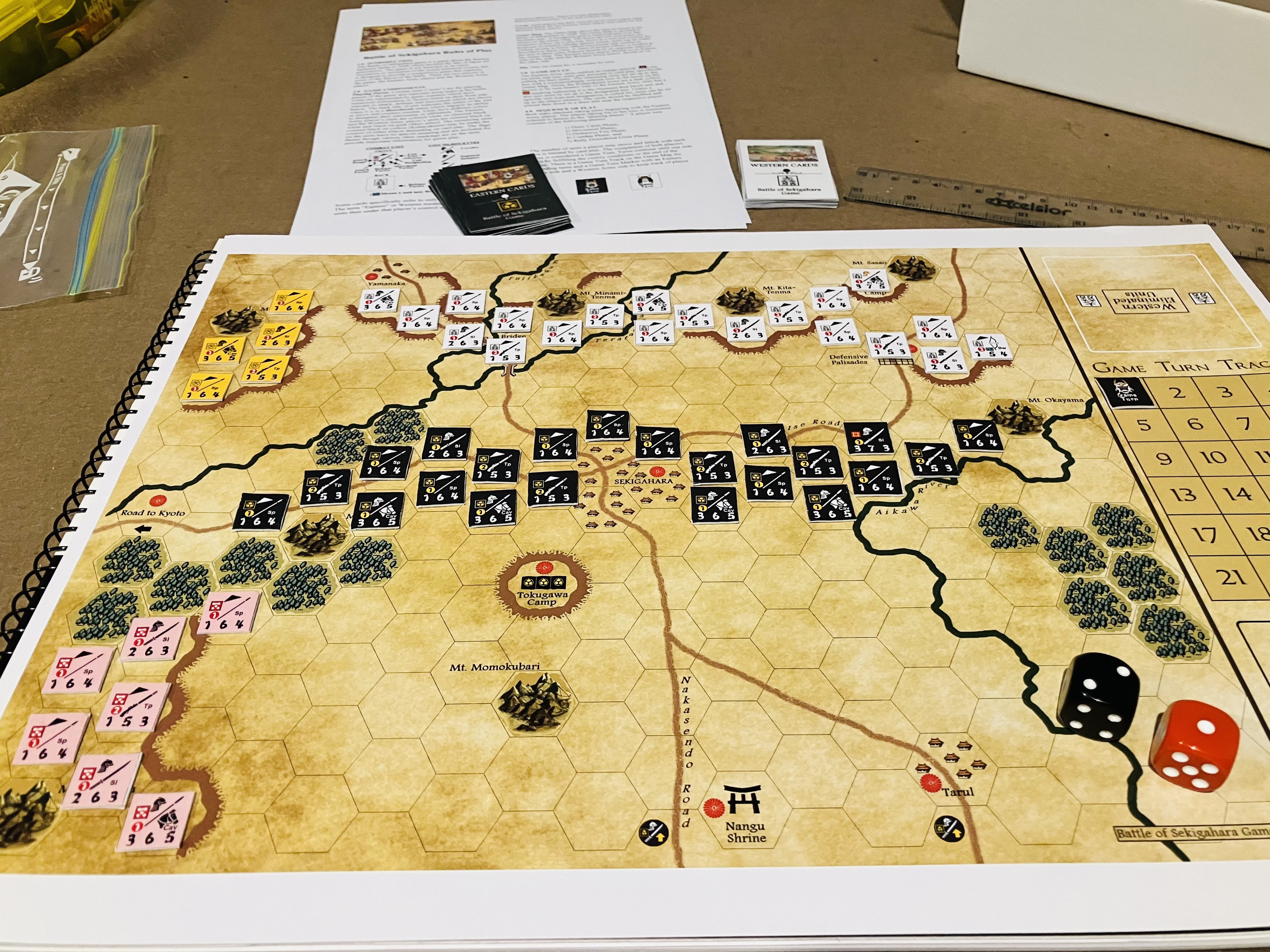
    The rules are straightforward and fit easily onto four pages. The only thing that tripped me up in my first game was remembering the defensive fire phase, where the opponent can shoot with missile units (arquebus and bow) right after movement and before the combat phase. I found the card mechanics with their events work well when playing solo adding a level of uncertainty.


    A recent print and play purchase

    After purchasing and downloading the game, the next step was printing. Since I don’t have access to a printer and needing the map on A3 paper (approximately 11 x 17 inches) I decided to go with an online printing service. The process proved to be quite simple: I just uploaded the rules, counters, cards, and map, and for each selected the paper size and quality. For example I had the map printed on their highest quality paper so it will be more durable. The printing arrived two business days later, not long to wait.


    Once the printouts arrived, I glued the counters onto card stock using a glue stick, then lined up and stuck on the counter backs. Finally once the glue was fully dry I cut them out. As for the cards, they came on one sheet of paper with the faces on one side and the backs on the other which all lined up nicely. These I covered with clear contact plastic, front and back, before cutting them out. This gave the cards some extra thickness along with durability. There are no pictures of this process as it is quite tricky putting the contact plastic on, one mistake and it all turns to custard.


    The printed front and back of the counters are glued to a piece of card and cut out.

    The completed cards. The printed cards came on one sheet of paper with the faces on one side and the backs on the other which all lined up nicely. These were covered with clear contact plastic, then cut out.

    So far, I have managed to play one game, where the Eastern Army under Tokugawa Ieyasu quickly defeated the Western Army under Ishida Mitsunari. Although the game ended up being a one-sided affair, probably due to my erratic tactics, I will definitely be playing some more games in over the next few weeks as a change from my mech games. One feature of the game I liked is each army has two clans on their flanks that are unreliable and may switch allegiances during the game, as directed by the event cards.

    The game setup ready to play.

    End of the game with an Eastern Army win.

    Looking ahead I am curious if parts of the game’s rules might be adapted for my samurai tabletop games. Something I would like to try once the house is finally set up. The ship with our goods has left Melbourne and with travel and customs it is looking like it we will be in around mid-December, which feels like it’s still a ways off. Although things are progressing, yesterday I was preparing and undercoating the room where I will be setting up my table and models.

    Tuesday, 29 October 2024

    Limited time

    I've been busy house painting every day to get the house completed before all our belongings arrive via ship. This is not exactly the kind of painting I enjoy, but there is satisfaction in getting the rooms complete. All this painting has meant my wargaming and blogging time has been limited. I did manage to fit in a mech game, though I have not found time to write it up yet.

    The start of a mech game which has to be written up.

    Yesterday, I took a break from painting as it was a public holiday here in New Zealand, and we were able to organise a family games day. In between having food we played two board games, starting with “Heat - Pedal to the Metal”, a racing car game where you manage a hand of cards to push your engine to its limits to get to the finish line first without spinning out on the corners. It was a very enjoyable game with some clever mechanics that kept everyone in the contest. At some point we all held the lead at different times, and no one fell behind until the last corner, where we pushed our engines to the maximum in a sprint to the finish line.

    The first game played

    The first lap underway

    The second game we played was “Betrayal at the House on the Hill”. A game where players explore a haunted house by placing tiles, gathering items and omens, and improving their characters’ abilities. At a certain point, the omens cause a shift in the game, transforming it from a game of exploration into one of survival. In our game, one player became an evil zombie lord tasked with hunting down the other characters using zombies. There are other survival scenarios in the game and the one selected is dependent upon the last omen found. 

    The second game played.

    The haunted house is explored.

    It was a fun games day.